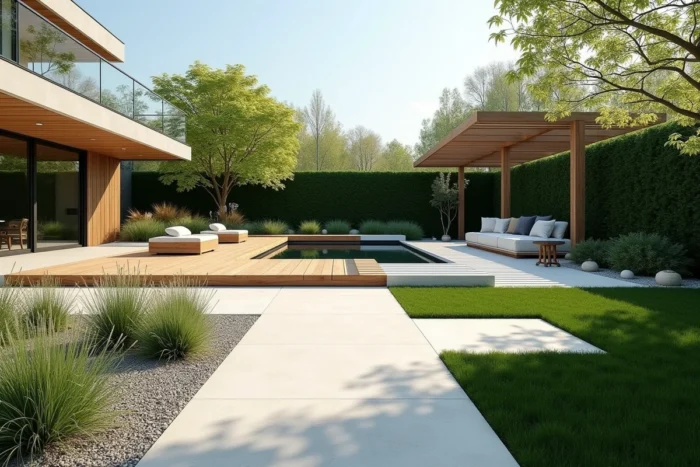
A contemporary garden relies on a balance between materials, volumes, and plants chosen for their texture as much as for their durability. We have selected ten concrete layouts that structure a modern outdoor space, taking into account current climatic and regulatory constraints.
1. Composite deck with staggered joints
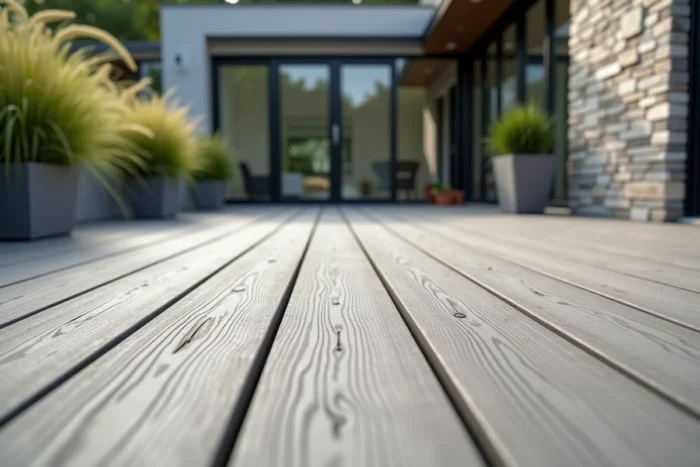
Composite (wood-polymer) remains the reference material for a contemporary deck. Its dimensional stability and UV resistance make it a technically superior choice to exotic wood in the long term, with almost no maintenance required.
We recommend a staggered joint installation of one-third of a board rather than a straight installation. This layout breaks the visual linearity and improves load distribution on the joists. Favor gray or anthracite shades, which absorb less heat than solid dark tones.
To explore more contemporary garden design ideas, the combination of composite decking and mineral beds provides a solid foundation for any project.
2. Aluminum fence with adjustable slats
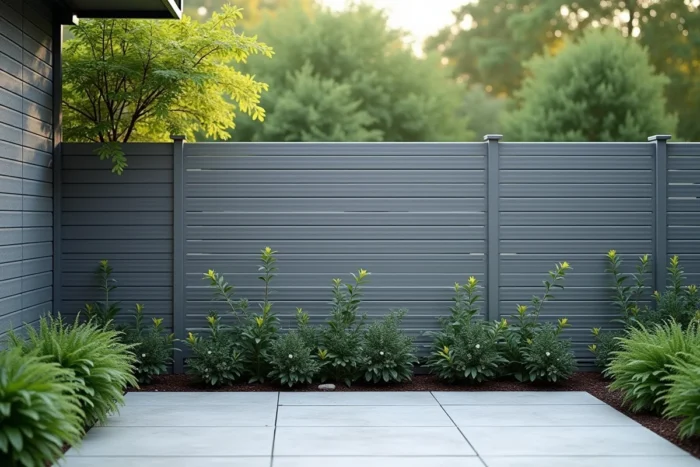
Aluminum fences with horizontal adjustable slats are a great replacement for traditional wood or PVC panels. Adjusting the angle of the slats allows you to modulate ventilation and privacy without sacrificing light.
Powder-coated aluminum requires neither staining nor sanding. Its profile thickness (generally around 1.5 mm) ensures sufficient rigidity against the wind, provided that the spacing of the posts is suitable for the terrain’s exposure.
3. Ornamental grass beds in a low layer
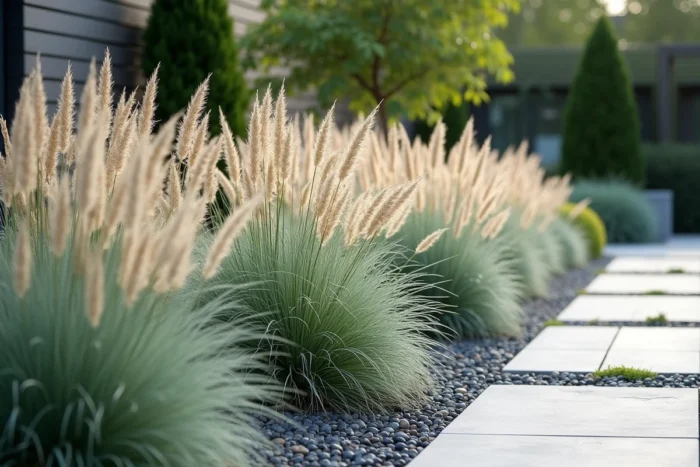
Grasses (Stipa tenuissima, Pennisetum, Carex) bring movement without excessive volume. Their drought tolerance makes them allies in a context of climate-resilient gardens, where heatwaves are becoming more frequent.
In a low layer, they function as ground cover and limit the growth of weeds. Planted in groups (a minimum of five plants per linear meter), they create a cohesive mat effect that structures the garden’s lines.
4. Recessed LED lighting along pathways
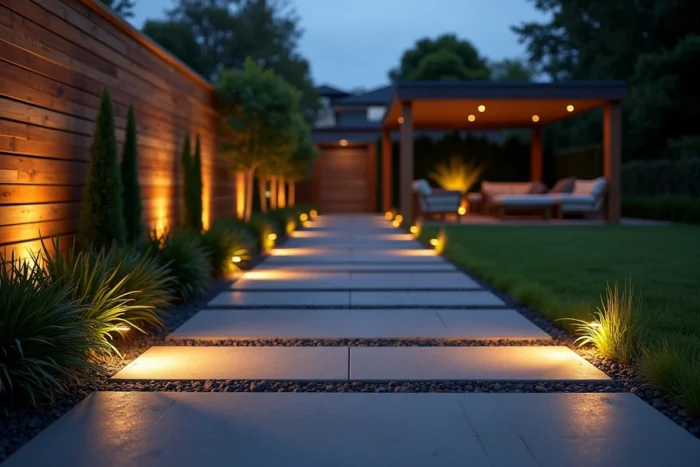
Recessed LED landscape lighting at ground level transforms a garden at dusk. Low-voltage (12 V) adjustable spotlights are sufficient to mark a pathway while highlighting plant volumes.
We observe that many projects overlook color temperature. For a contemporary garden, a warm white between 2,700 K and 3,000 K avoids the cold effect of public lighting. Tall posts, on the other hand, disrupt horizontal lines: they should be reserved for safety areas.
5. Bioclimatic pergola with adjustable slats
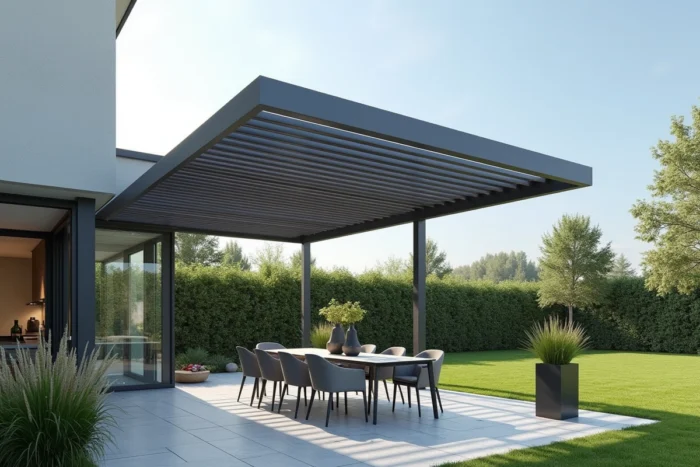
The bioclimatic pergola has become a structural element of the modern garden. Its adjustable slats regulate sunlight and rainwater drainage without the need for an additional awning.
Regulatory point of caution: the development tax applies as soon as a covered area exceeds 5 m² and 1.80 m in ceiling height. The flat rates vary by municipality, which can significantly affect the budget. Check with your town hall before signing a quote.
6. Tiered garden with gabion walls
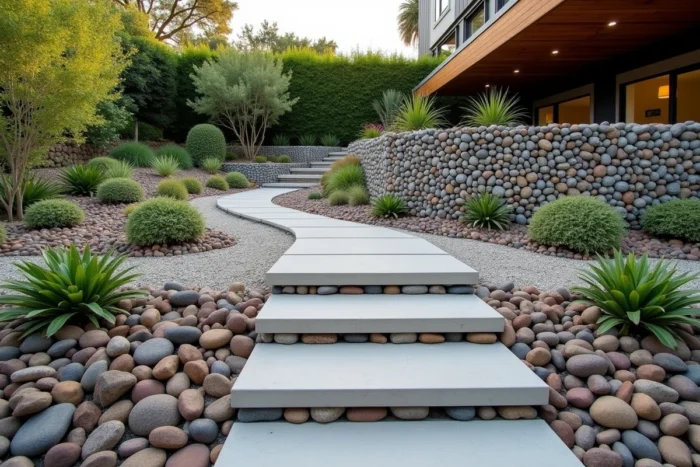
Structuring a garden into successive terraces creates depth on a flat terrain. Gabion walls (metal cages filled with pebbles or local stones) serve both as support and decorative elements.
Their technical advantage: they are permeable, which promotes natural drainage and limits runoff during heavy rains. This is a direct response to current recommendations for sustainable stormwater management at the parcel level.
7. Minimalist ornamental pond in corten steel
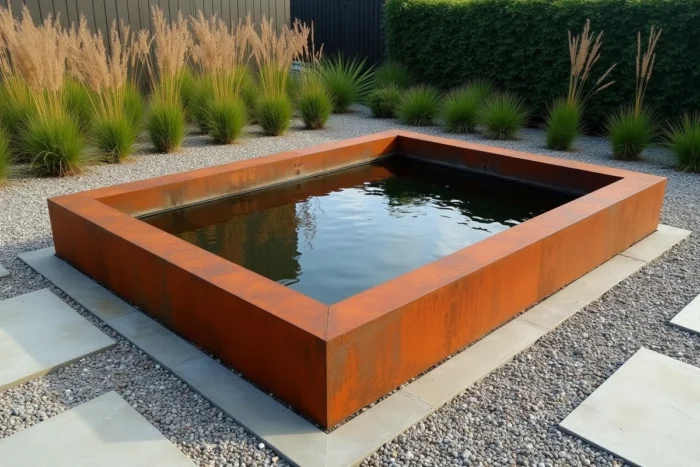
A shallow corten steel pond provides a water mirror without the complexity of a pool filtration system. The natural rust patina of corten integrates with current plant palettes.
Common dimensions: rectangular, reduced length, depth of a few dozen centimeters. A simple recirculation system with a solar pump is sufficient to keep the water clear. Key point: a pond of this size remains below the threshold for the development tax applicable to pools.
8. Mineral covering with stabilized gravel
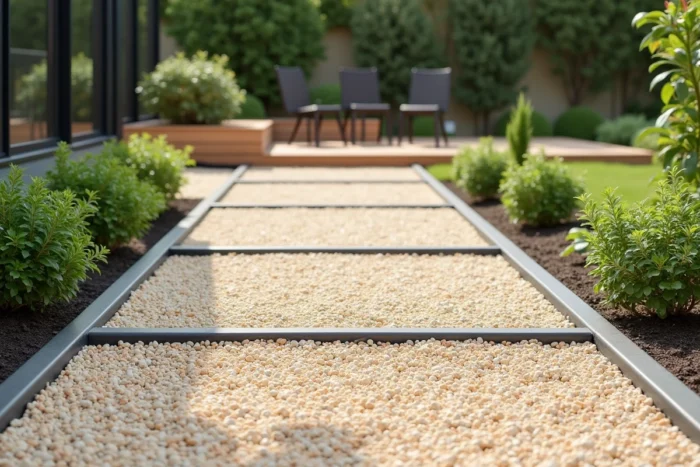
Stabilized gravel (laid on a cellular slab) offers a clean mineral finish characteristic of contemporary style while remaining permeable. It is an alternative to exposed aggregate concrete, less expensive and easier to implement.
Three selection criteria for the aggregate:
- Granulometry of 6/10 mm for good blockage in the cells and walking comfort
- Light shade (limestone, beige, light gray) to limit heat absorption in summer
- Local origin preferred, to reduce transportation costs and carbon footprint
9. Relaxation area with integrated outdoor fireplace
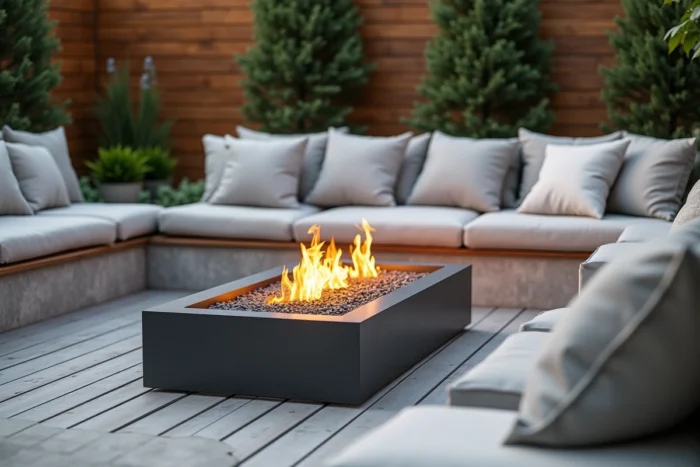
The outdoor fireplace (integrated fire pit or fiber-reinforced concrete chimney) extends the use of the garden in mid-season. Positioned away from the main terrace, it creates a second living space with its own atmosphere.
High-performance fiber-reinforced concrete withstands repeated thermal shocks. We recommend a raised base of at least two blocks to insulate the fireplace from the ground covering and facilitate airflow.
10. Climbing plants on tensioned stainless steel cables
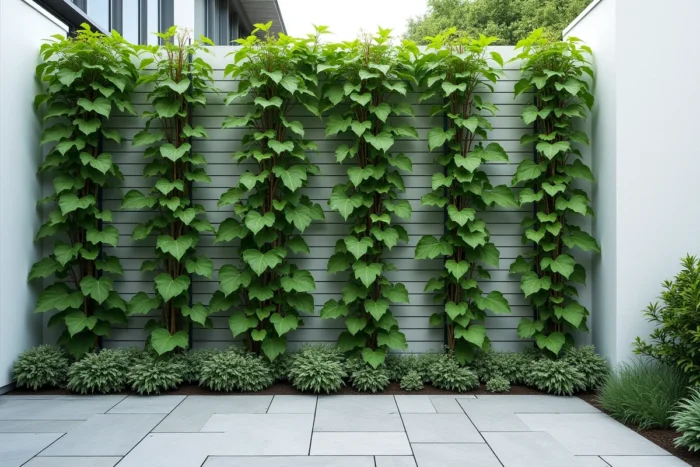
Climbing plants on tensioned stainless steel cables dress a blank wall or fence without the thickness of wooden trellis. The system of horizontal cables spaced 30 to 40 cm guides growth and facilitates pruning.
Star jasmine, Trachelospermum, or small-flowered clematis are suitable for temperate climates. Their evergreen or semi-evergreen foliage maintains the plant effect even in winter, a criterion we consider decisive for a garden that aims to be structured all year round.
These ten layouts can be combined according to the size and orientation of the terrain. The common thread remains the coherence of materials: composite, aluminum, corten steel, and fiber-reinforced concrete form a limited palette that avoids a catalog effect. Before starting any work, checking the development tax threshold and local urban planning rules is a necessary step.