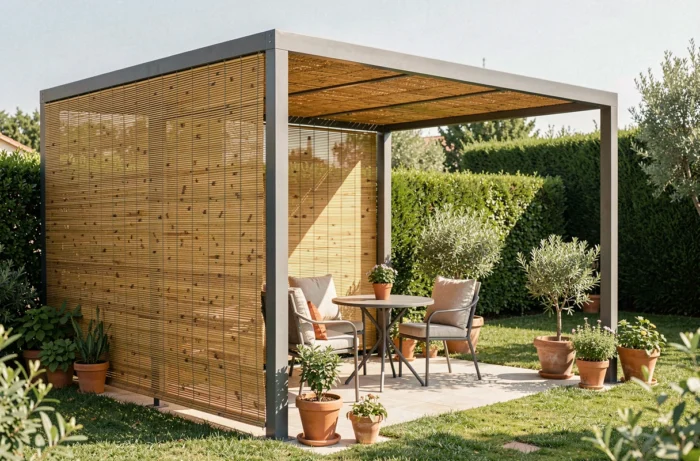
Installing a bamboo screen on a pergola is often the first instinct to create shade without undertaking major work. Bamboo is appealing due to its raw appearance, affordable price, and ease of installation. However, this natural material also imposes constraints that are sometimes discovered after the first season.
Thermal constraints and fire risk: what bamboo implies under a pergola
Have you noticed that a bamboo screen exposed to the summer sun radiates a distinct dry heat? Unlike fabric or adjustable slats, bamboo absorbs heat and releases it downwards. Under a pergola attached to a wall, this effect can reduce comfort instead of enhancing it.
Bamboo is also a combustible material, which poses a real issue in fire-prone areas. In France, the legal obligation for brush clearance now extends to more departments. It requires limiting flammable materials near buildings. From January 2025, this obligation must even be included in real estate information documents in the affected areas.
Specifically, if your pergola is located in an area subject to these regulations, installing a bamboo screen may contradict fire prevention requirements. This is a criterion that is rarely mentioned but deserves verification with your local authority before any purchase.
Natural appearance and privacy: the true advantages of bamboo on a pergola
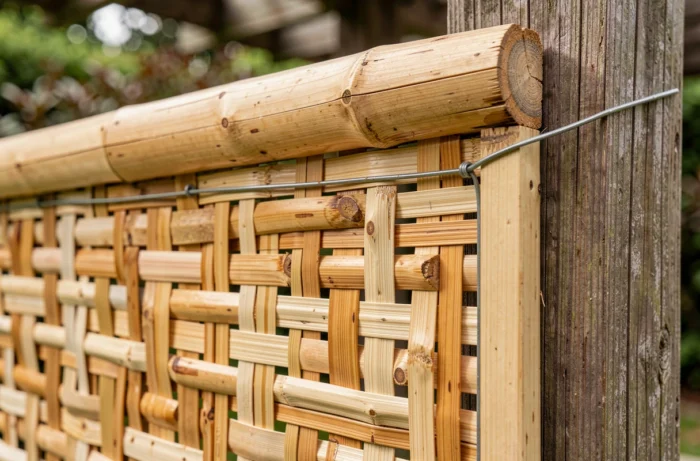
The first strong point of bamboo remains its natural appearance that blends into a landscaped garden. The stems retain their diameter variations and color nuances. No roll looks exactly like another, which avoids the uniform plastic effect of a PVC screen.
To properly weigh the advantages and disadvantages of bamboo screens for pergolas, one must also consider the level of privacy. Whole bamboo offers dense coverage, while split bamboo allows more light to filter through. On a pergola, this choice radically changes the ambiance: sharp shadow or diffused light.
The installation is quick. A roll is attached to the structure with galvanized wire or ties. No specialized tools or drilling are needed in most cases. This is a real advantage compared to rigid solutions like wooden or aluminum slats.
Durability and maintenance of an outdoor bamboo screen
Here is the point that often sways the decision. An untreated bamboo screen degrades within a few seasons. Moisture causes mold, and the sun causes the stems to gray and then break. On a pergola, the screen is constantly exposed to the elements from above, without the partial protection offered by a fence wall.
Applying a protective product extends the life of bamboo, but this operation has its own constraints. A bamboo protector should not be applied below a certain temperature or above a high humidity level. In practice, the treatment window is limited to spring and early autumn in many regions.
Signs of degradation to watch for
- Stems splitting lengthwise, indicating advanced drying after several sun-rain cycles
- Black or greenish spots on the bamboo nodes, indicating the onset of mold due to stagnant moisture
- A loosening of the connecting wire between the stems, which weakens the whole structure and can create sagging areas on the pergola
When these signs appear, partial replacement is rarely satisfactory. The color difference between new and old stems remains visible. Planning for a complete replacement every three to five years is a realistic estimate for a screen installed horizontally on a pergola.
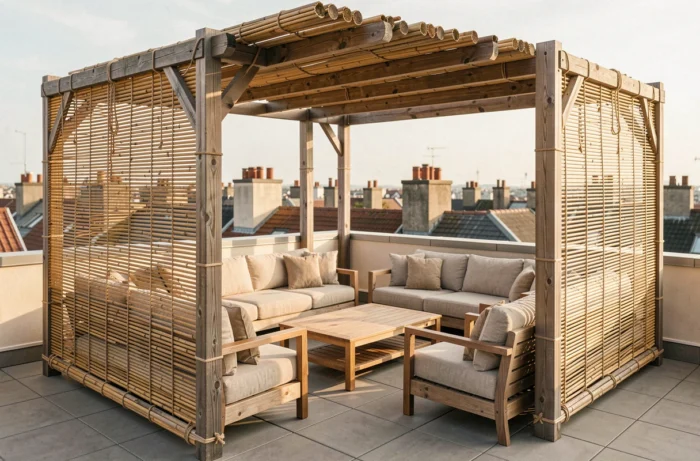
Bamboo screen or PVC screen for pergola: concrete selection criteria
Bamboo imitation PVC has been around for a long time, and the visual quality has improved. So why choose real bamboo? And in what cases is it better to avoid it?
When natural bamboo remains the best choice
If your pergola is surrounded by vegetation, wood, or stone, natural bamboo integrates without visual disruption. PVC, even when well imitated, retains a regular appearance that contrasts with an organic environment. For a pergola in a landscaped garden, bamboo provides an aesthetic coherence that PVC cannot replicate.
Bamboo is also suitable when one is willing to renew the screen regularly. Its cost per roll remains among the lowest in the shading solutions market.
When PVC takes the advantage
By the sea, in very windy areas, or in a humid climate, PVC does not mold and does not break down due to salt or water. It requires no treatment. Its maintenance-free durability more than compensates for its less authentic appearance.
On a pergola used as a daily living space (dining, outdoor lounge), the reliability of PVC avoids the inconveniences of falling stems or plant debris in the plates.
Quick comparison table
| Criterion | Bamboo screen | PVC screen |
|---|---|---|
| Aesthetic | Natural, irregular | Regular, imitation |
| Life span on pergola | Several seasons with maintenance | Several years without maintenance |
| Maintenance | Annual treatment recommended | Cleaning with water |
| Wind resistance | Average (rigid stems) | Good (material flexibility) |
| Fire risk | Combustible | Variable depending on composition |
The choice between bamboo and PVC for a pergola ultimately depends on two parameters: the visual environment in which the structure is situated, and the time you are willing to devote to maintenance. A bamboo screen installed on a pergola in a shaded and wind-sheltered area can hold up well. The same screen exposed full south on an open pergola will require frequent renewal, and it is this discrepancy between the product’s image and its actual use that generates the most disappointment.