
The development of the infant does not follow a linear timeline: each motor, sensory, or nutritional acquisition depends on specific windows of neurological maturation. We regularly observe delays of several weeks between two children of the same age, without this indicating a delay. Understanding the needs of the baby month by month requires distinguishing reliable motor milestones from normal individual variations.
Primitive reflexes and axial tone: what happens before the third month
At birth, the motor repertoire relies on primitive reflexes (grasping, Moro, automatic walking). Their persistence beyond the fourth month may signal a neuromotor integration issue. We recommend checking for the gradual disappearance of the Moro reflex between 3 and 5 months.
Axial tone, often overlooked in popular guides, is the true marker of the first trimester. A baby who briefly holds their head up in a prone position by the sixth week shows normal cervical maturation. Stable head control, acquired by the end of the third month, conditions everything that follows: sitting, voluntary grasping, spoon feeding.
The first sounds produced at this age (cooing, open vowels) are precursors to language. They are not random: the infant reproduces vocal frequencies they have memorized in utero. Face-to-face interaction, with vocal feedback from the adult, reinforces these circuits.
Exploring all the sections of Future Maman allows for a deeper understanding of each stage with age-appropriate markers for the infant.
Free movement and sensory awakening between 4 and 8 months
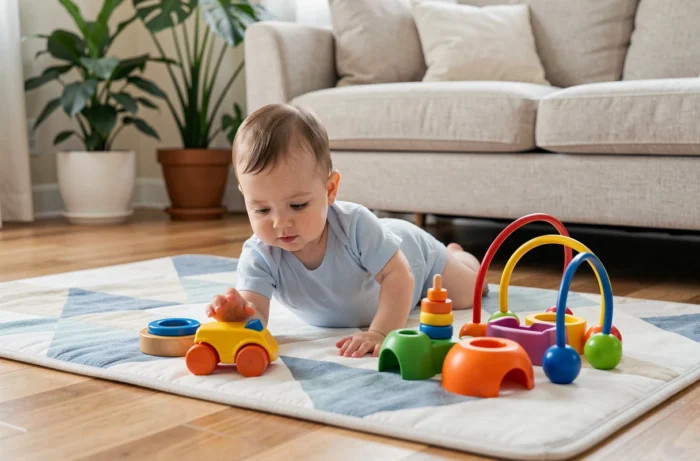
Free movement remains the most effective method for structuring the body schema. Placing the baby on a firm mat, without a bouncer or cushion, allows them to access spontaneous postural sequences: rolling from back to belly, pivoting, crawling. Each intermediate posture strengthens the muscle chains necessary for autonomous sitting.
Between the fifth and sixth months, voluntary grasping replaces the reflexive grasping. The infant grabs an object, transfers it from one hand to the other, and brings it to their mouth. This action combines eye-hand coordination and oral exploration, two distinct functions.
Games and objects suitable for this period
- Objects with contrasting textures (raw wood, fabric, food-grade silicone) that stimulate tactile discrimination without over-stimulating the child
- Light rattles with a palmar grip, then with a radial grip around 7 months, to accompany the maturation of the pincer grasp
- Simple sound activities (maracas, bells) that associate movement with sound and reinforce the sensory-motor loop
- Unbreakable mirror placed on the floor to promote body awareness and early simulated social interactions
An excess of toys produces the opposite effect of what is sought. Three to four rotating objects are sufficient to maintain engagement without causing attention dispersion.
Infant feeding: diversification and signals of digestive maturity
Food diversification does not start on a fixed date. We observe that it relies on the convergence of several signals: stable head control, disappearance of the tongue extrusion reflex, clear interest in solid foods, ability to sit with minimal support.
In practice, this convergence rarely occurs before the end of the fifth month. Breast milk or infant formula covers all nutritional needs until this age. The introduction of new foods is then done through repeated exposures: the same vegetable offered several days in a row, in small quantities, before moving on to the next.
Textures and progression between 6 and 12 months
The texture of the first meals should evolve quickly. Staying too long on smooth purees delays the learning of chewing and can complicate the acceptance of chunks after 9 months. Offering lumpy textures as early as 7 months prepares the jaw for solid foods.
By 8-9 months, soft-cooked vegetable sticks allow the baby to work on the pincer grasp while eating. This fine motor grasp serves both feeding and the development of finger dexterity, which will be useful much later for writing.

Emotions, sleep, and screen prohibition before age 3
The emotional development of the infant relies on co-constructed regulation with the adult. Before 8 months, the baby does not distinguish their emotions: they react with global states (pleasure, distress). Separation anxiety, which appears around the eighth month, marks a major cognitive advance, the permanence of the object.
Sleep structures gradually. The short cycles of the newborn (about 50 minutes) lengthen around 4-5 months, with the onset of deep slow sleep at the beginning of the night. Autonomous falling asleep is generally acquired between 4 and 6 months, provided a stable sensory environment is maintained (darkness, constant white noise, short ritual).
Screens: from recommendation to regulatory prohibition
Since the decree of June 27, 2025, published in the Official Journal on July 2, 2025, exposure of children under 3 years old to screens is formally prohibited in all early childhood care facilities (nurseries, micro-nurseries, childminders), even when the screen is simply on in the background. This prohibition replaces the previous recommendation, creating a notable gap between the rules in professional care settings and practices at home.
For parents, the guideline remains the same: no screens before age 3. Sounds, sensory play, and direct interaction with adults provide stimulations that screens cannot replace, and data on the negative impact of passive screens on language acquisition are consistent.
The development of the baby month by month is not just about ticking boxes on a chart. Each acquisition, from the first roll to the first bite of mashed broccoli, is part of a sequence where motor skills, nutrition, and emotions mutually influence each other. Regularly observing your child, adjusting stimulation proposals, and respecting their own pace remain the most reliable levers.