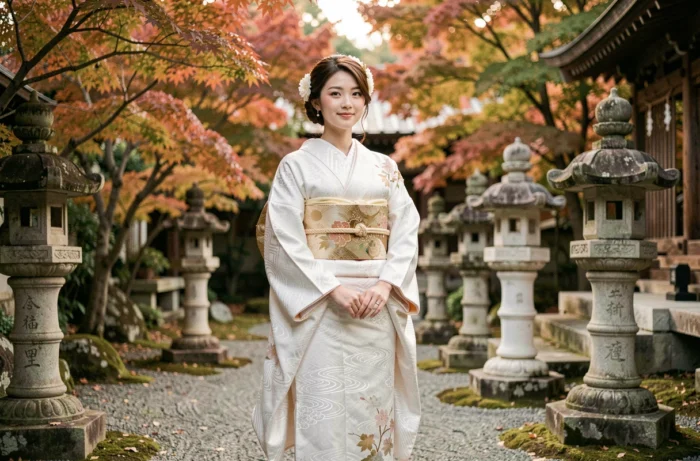
Each culture has built its own rules to formalize a union. Marriage, beyond the legal framework, functions as a condensation of family, religious, and social values specific to a territory. Understanding these variations allows us to grasp what each society considers the foundation of a legitimate couple.
Legal Framework of Marriage: What Changes from Country to Country
Civil marriage, as it exists in France since the Revolution, is not a global standard. In several countries in the Middle East or South Asia, religious marriage serves as a legal act, without going before a distinct civil authority. The validity of the union then depends on the rite performed and the religious authority overseeing it.
The question of legal age illustrates these disparities well. While France sets the marriageable age at 18 (with rare exceptions), other legislations allow for much earlier unions, sometimes as soon as puberty, provided there is family consent.
Another legal marker concerns marriage between same-sex individuals. In 2026, Bolivia celebrated its first same-sex marriage, described as historic by Human Rights Watch. This type of advancement remains concentrated in a few dozen countries, primarily in Western Europe and America. The majority of legislations worldwide still do not recognize these unions.
To access all information on Mariages du Monde, a portal that lists cultural and practical specifics related to ceremonies on each continent.
Ceremony Rituals: Symbolic Functions of Wedding Traditions
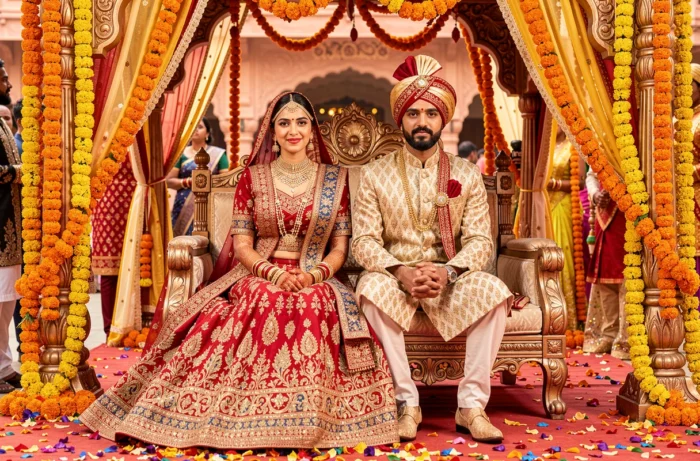
Wedding rituals are not mere folklore. Each serves a specific function in the social organization of the couple and the extended family.
In Germany, the engaged couple must saw a tree trunk together in front of their guests. This act is not decorative: it publicly tests the couple’s ability to collaborate physically under pressure. The ritual validates marital solidarity before the community.
In South Korea, the groom undergoes a ritual where his feet are struck before the wedding night. The ordeal, often accompanied by laughter, aims to test his endurance and good humor in the face of adversity. The comedic aspect masks a social function: to show families that the future husband accepts discomfort with grace.
In Scotland, the “blackening of the bride” involves covering the future wife with various substances (soot, flour, molasses) before the wedding. This rite of voluntary humiliation symbolizes the ability to face the trials of married life. The underlying idea: if the bride can endure this public ordeal, she will overcome the difficulties of daily life.
These three examples share the same principle: marriage is earned through a visible trial, not just through a declaration of intent.
Micro-wedding and Slow Wedding: New Forms of Ceremony
Since the mid-2020s, two trends have been restructuring how couples conceive their marriage, regardless of their culture of origin.
The micro-wedding refers to a wedding with fewer than 50 guests. This format, popularized during the post-Covid period, has firmly established itself in North America and Europe. The initial motivation (health constraints) has given way to a deliberate choice: to reduce the number of guests to allocate more budget to the quality of the experience.
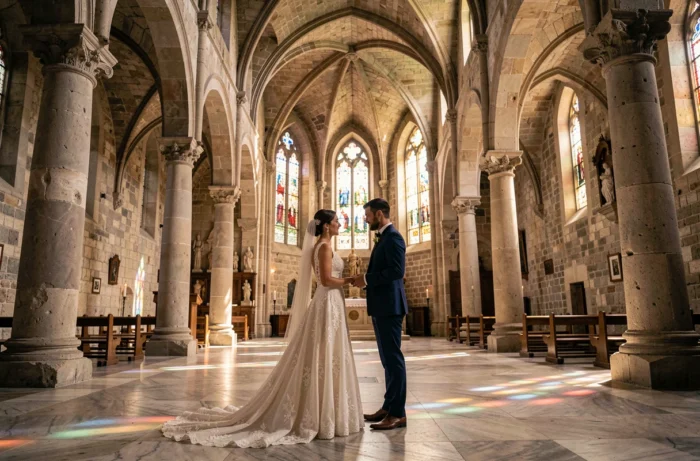
The slow wedding extends this logic. The ceremony spans an entire weekend, or even several days, with a deliberately slowed pace. The goal is to prioritize real exchanges between guests and the couple, rather than rushing through the steps of a timed program.
These two formats share several characteristics:
- A budget refocused on the experience rather than the logistics of a large number of guests
- A high degree of customization of the ceremony, often breaking away from local traditional codes
- A trend towards digital disconnection, with areas or moments without phones during the celebration
These evolutions do not eliminate traditions. They redistribute them: a couple can incorporate an ancestral family ritual into a micro-wedding format, making it more intimate and meaningful for the present participants.
Budget and Organization: The Invisible Variables of Marriage
The financial question structures marriage as much as tradition does. In many countries, the bride’s family bears the majority of the costs. In others, the burden falls on the groom or is shared between the two families according to specific rules, sometimes codified by custom or religion.
The system of dowry, still practiced in several regions of South Asia and Africa, sometimes conditions the very possibility of marriage. The financial capacity of the family determines access to marriage, not just the couple’s preferences.
In the West, the continuous rise in costs related to venues, caterers, and service providers partly explains the success of micro-weddings. Reducing the number of guests allows for maintaining a high level of celebration without disproportionate debt.
- The choice of venue (town hall, place of worship, private space, destination abroad) depends on the budget, family tradition, and local legislation
- Organization varies from entirely family-led planning (common in Asia and Africa) to almost total delegation to a wedding planner (frequent in North America)
- The duration of festivities ranges from a few hours (simple civil marriage) to several days (Indian weddings, Moroccan weddings)
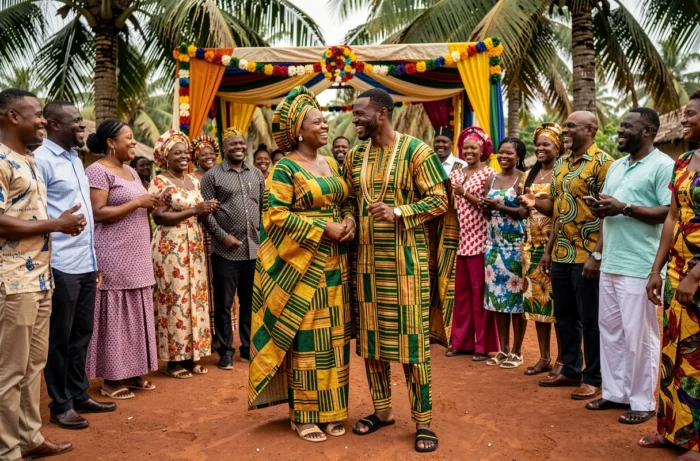
Understanding a marriage through the lens of budget often reveals more about a society than studying its rituals alone. The way a culture distributes costs between families reflects its conception of alliance, symbolic debt, and the social status of the newly formed couple.