When you place a plate on the table, you don’t always think about what it conveys. Its material, color, and the thickness of its rim change the perception of a dish. The tableware from Jeanne’s collection is designed to pay attention to this detail, with porcelain pieces intended for everyday meals as well as special occasions.
Food Safety and Tableware: What Regulations Really Require
Have you ever flipped a plate over to read the markings on the back? Most consumers never do. Yet, this is where part of the quality of a product intended for food contact is determined.
Since January 1, 2023, the AGEC law requires establishments that can accommodate at least 20 diners to serve food on reusable tableware for meals consumed on-site. Plates, cups, cutlery, containers: everything must be washable and reusable. This obligation has pushed many restaurateurs and caterers to renew their stock.
Choosing a collection like Jeanne’s tableware allows compliance with this requirement without sacrificing aesthetics. Porcelain, fired at high temperatures, offers a dense surface that limits the migration of substances into food.
Inspections by the DGCCRF on food contact materials have intensified in recent years. They target the presence of heavy metals, unauthorized substances, or incomplete markings. A quality porcelain product, manufactured according to European standards, has a clear advantage in this area compared to decorative tableware imported without clear traceability.
Porcelain, Earthenware, or Stoneware: Choosing the Right Material for Your Plates
These three materials are consistently mentioned when discussing tableware. They do not have the same properties at all, and the choice influences durability, maintenance, and visual appeal.
Porcelain: The Reference Material for Table Art
Porcelain is fired between 1,200 and 1,400 °C, making it non-porous. It does not retain odors or food coloring. Its finesse allows for lightweight plates with good resistance to thermal shock (from oven to refrigerator).
It is the preferred material for high-end collections and is used in the Jeanne range. It can go in the dishwasher without losing its luster, a crucial criterion for everyday use.
Earthenware and Stoneware: Alternatives with Limitations
Earthenware, being more porous, absorbs moisture if the glaze is damaged. It is suitable for decorative tableware or occasional use. Stoneware, more rustic, is quite durable but offers a less refined visual appeal. It is often heavier.
- Porcelain: lightweight, non-porous, dishwasher-safe, bright finish
- Earthenware: fragile glaze, prone to chipping, artisanal aesthetic
- Stoneware: robust but heavy, matte surface, suited for a country style
The choice depends on the intended use. For a complete service used several times a week, porcelain remains the best compromise between elegance and durability.
Creating a Cohesive Tableware Set Without Matching Everything
The era of having identical service for all pieces is fading. Current trends in table art favor a controlled mismatch: flat plates in one color, deep plates in another, connected by a common thread (same material, same manufacturer, same palette).
Why this choice? An overly uniform service gives a static impression. In contrast, mixing two or three references from the same collection creates depth without falling into disorder.
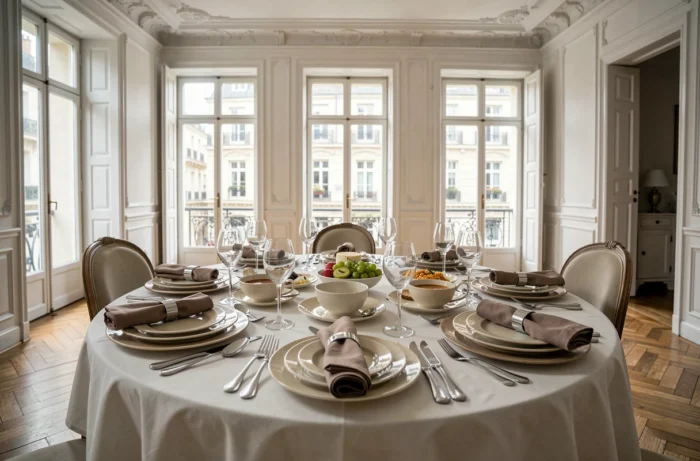
Practically, you can start with a neutral base (white, ivory, light gray) for the flat plates, then introduce a more distinctive piece for the bowls or cups. The Jeanne collection, with its clean lines, lends itself well to this exercise because its shapes remain compatible with each other.
Cutlery and Accessories: Extending the Cohesion
Brushed stainless steel cutlery pairs well with light porcelain tableware. Matte stainless steel avoids the overly shiny contrast that can distract from the dish. A cutlery set that matches the style of the table simplifies the composition.
- Opt for a set of 18/10 stainless steel cutlery for corrosion resistance
- Match the shape of the handles (rounded or straight) to the style of the plates
- Add a signature piece (casserole, serving dish) to anchor the design
A well-set table relies on a maximum of three elements: the tableware, the cutlery, and the table linen. Beyond that, the table loses clarity.
Maintaining Porcelain Tableware: Preserving Quality Over Time
Quality porcelain ages well, provided you follow a few simple precautions. The dishwasher poses no problem for pieces that are not hand-decorated. However, hand-painted or gilded decorations do not withstand intensive cycles well.
Avoiding abrasive products and metal sponges protects the glaze in the long term. A simple rinse with hot water after use is sufficient for common stains.
Storage also matters. Stacking plates without protection causes micro-scratches on the glaze. Placing a thin cloth or felt between each piece prevents this type of damage, especially for a service used on special occasions.
Porcelain has no expiration date. A well-maintained service can last for decades. This is, in fact, one of the most concrete arguments in favor of investing in quality tableware rather than products that are replaced every two years.