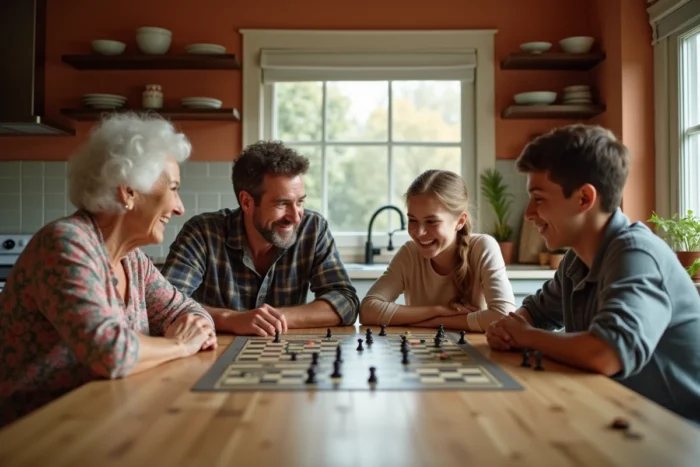
Organizing an afternoon that appeals to a six-year-old, a teenager, and a grandparent with reduced mobility often feels like a puzzle. Most lists of leisure activities present ideas without considering whether they actually work when three generations share the same space. Adapting the pace, physical level, and enjoyment for everyone requires a bit of method, but options exist, far beyond just board games.
Intergenerational leisure: what “for all ages” really means
Have you ever noticed that activities labeled as “family-friendly” often exclude seniors or people with reduced mobility? A ropes course is suitable for children and sporty adults, but it leaves out a grandmother with joint pain. A ceramic painting workshop, on the other hand, can be done while seated, without the need for strength or speed.
A truly inclusive activity relies on three criteria: low physical demand, simple rules, and shared enjoyment. Community centers in some cities, like Lorient, have developed projects that bring children and seniors together around common workshops. The goal goes beyond entertainment: it’s about creating social connections and combating the isolation of older adults.
Several associations also offer “day holidays” for isolated seniors, with outings tailored to their autonomy. These short formats, easy to organize, can inspire any family looking to include a fragile loved one in their leisure activities. A variety of ideas categorized by audience can also be found on the Aipdb leisure site, allowing for filtering according to individual constraints.

Family activities: four formats that work for every age
Instead of listing twenty superficial ideas, let’s focus on four formats whose mechanics naturally adapt to participants of very different ages.
The scavenger hunt or adapted treasure hunt
A scavenger hunt in a park or garden works because everyone finds their role. Children run, teenagers decipher clues, and adults manage the strategy. A senior can hold the map or validate answers without needing to move constantly. The pace of the game adjusts to the slowest participant, without frustrating the faster ones.
To design it, a few sheets of paper, a pen, and an hour of preparation are enough. No need for expensive materials or reservations.
The shared cooking workshop
Cooking brings together simple actions (peeling, mixing, decorating) and more technical tasks (cutting, cooking, seasoning). A four-year-old decorates cookies while a teenager prepares the dough. Grandparents pass down recipes and supervise the cooking.
The cooking workshop creates a tangible result that everyone shares at the end. This feeling of having made something together strengthens the bond much more than a passive activity like watching a movie.
Cooperative board games
Competitive games sometimes generate frustrations among players of very different levels. Cooperative games, where all participants win or lose together, eliminate this problem. The market today offers titles accessible from age five, with mechanics deep enough to engage adults.
The nature outing at a leisurely pace
A walk in the forest, a visit to a botanical garden, or an afternoon by a lake impose neither a timer nor rules. Everyone moves at their own pace. Children explore, adults walk, and less mobile individuals can settle at a fixed point with a side activity (drawing, bird watching, reading).
- Plan a route with benches or regular resting points for people with reduced mobility
- Bring a “satellite” activity (sketchbook, plant identification guide) to occupy those who remain seated
- Choose a location accessible by stroller and wheelchair, which excludes steep trails but opens the door to well-maintained parks

Escape rooms, creative workshops, and supervised activities: how to check accessibility
Commercial activities (escape rooms, creative workshops, pottery classes) often display a minimum age, but rarely a maximum age or information about physical accessibility. Before booking, a few checks are necessary.
Are you looking for a family-friendly escape room? Check that the room offers a scenario suitable for children and that the space is accessible for those who cannot stand for long periods. A good provider specifies the physical constraints of each activity on their booking page.
For creative workshops (painting, sculpture, sewing), ask if the tables are adjustable in height and if the materials are suitable for both children’s hands and those of people suffering from arthritis. These details may seem trivial, but they make the difference between a successful outing and a frustrating experience for part of the group.
- Call the provider to confirm wheelchair or stroller accessibility
- Ask if the activity can be done while seated
- Check the total duration: beyond two hours, fatigue may exclude the youngest and oldest
- Prefer structures that clearly display their reception conditions for people with disabilities
Local activities and social connections: moving away from consumerism
The most inclusive leisure activities are not always the most expensive. Local initiatives, led by community centers, social services, or associations, offer free or low-cost activities designed for diverse audiences. In the Landes region, some missions aim to create intergenerational bonds by organizing simple meetings among residents of all ages.
Public programs for youth access to leisure make certain activities available to families that would otherwise be excluded. These aids are not limited to vacations: they also cover occasional outings, workshops, and internships.
Thinking of leisure “for all ages” ultimately comes down to asking a simple question before each choice: who in the group might not be able to participate? If the answer is “no one,” the activity is worth considering. Inclusivity in leisure does not require a higher budget, but rather a finer attention to everyone’s constraints.