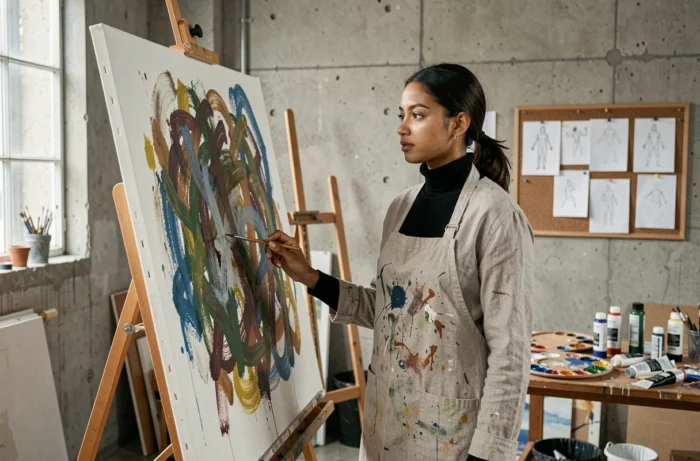
Astrée Lhermitte-Soka is a French painter whose career is marked by a radical choice: to build a solid painting practice without resorting to the media levers that structure the contemporary art market. Trained at the Savannah College of Art and Design in Georgia, she transitioned from graphic design in New York to film makeup, ultimately converging towards painting with an unusual technical background for the visual arts scene in France.
Savannah College of Art and Design: a technical training that shapes practice
The choice of the Savannah College of Art and Design (SCAD) deserves attention. This American institution trains graphic designers and illustrators through a very applied approach, far from the dominant conceptual teaching in European art schools. Astrée Lhermitte-Soka earned a dual degree in graphic design and illustration, which implies a mastery of composition, typography, and the text-image relationship even before approaching the canvas.
This background partly explains the uniqueness of her pictorial work. A SCAD education produces artists who think about framing, visual hierarchy, and the readability of a plan. When this graphic grammar migrates to painting, it generates works where structure takes precedence over spontaneous gesture.
To delve deeper into Astrée Lhermitte-Soka’s journey, one must look back to those American years that laid the foundations of her working method.
After her studies, she lived for about three years in New York working as a graphic designer. This immersion in the New York art scene, even through the lens of commercial design, provides fertile ground that nourishes her subsequent painting.
Painter outside the media circuit: what discretion concretely changes
Astrée Lhermitte-Soka’s near-total absence from mainstream media is not an accident, it is a positioning. In an art market where digital visibility conditions access to galleries, collectors, and residencies, operating without press coverage or presence on social media is a choice with significant consequences.
We observe that the available sources on her recent activity come almost exclusively from secondary biographical pages or celebrity media, never from exhibition catalogs, art journals, or institutional press releases. This gap between actual artistic production and the absence of accessible professional documentation poses a concrete problem: the reception of her work remains filtered through her lineage with Thierry Lhermitte rather than through a critique of her work.
This configuration is indicative of a broader phenomenon in the visual arts in France. An artist without an affiliated gallery, without a presence on Artsy or Instagram, without documented residencies, exists in a blind spot of the market. Their production circulates through other channels, often private, making any public evaluation of their work impossible.
From graphic design to film makeup: a rare multidisciplinary trajectory in painting
Before dedicating herself to painting, Astrée Lhermitte-Soka worked in film makeup. This rarely discussed stage, however, provides technical insights into her practice. On-set makeup requires knowledge of pigments, textures, artificial light, and how color behaves under different lighting conditions.
The skills accumulated through these professions form a multidisciplinary foundation:
- Graphic design gives her compositional rigor and visual space management, skills directly transferable to framing a canvas
- Illustration develops storytelling through images, a dimension present in works like Doux-sœur or Les robes porte-bonheur
- Film makeup sharpens the perception of pigments, skin tones, and the behavior of colored material on a living surface
This convergence of technical know-how distinguishes her approach from that of artists from a traditional fine arts background. Painting does not arrive as the first medium but as a synthesis of prior practices.

Lhermitte lineage and artistic reception: a framework that weighs
Daughter of Thierry Lhermitte and Hélène Aubert, sister of Victor and Louise (known as Lonny), Astrée grows up in a family environment where paternal notoriety creates a distorting prism. The majority of articles mentioning her name open with her lineage before addressing her work. This editorial reflex is not trivial: it conditions how the public discovers and categorizes an artist.
In the visual arts community, being identified as “the child of” hinders legitimization by peers. Exhibition curators, critics, and informed collectors tend to overcompensate by demanding a more documented, more exposed, more critiqued production. Astrée Lhermitte-Soka’s discretion, which could be an asset in another context, amplifies the problem here: without accessible critical corpus, lineage remains the only available framework for interpretation.
We should also note the older artistic heritage of the family: among the ancestors are painter Léon Lhermitte and neurologist Jean Lhermitte. This lineage places Astrée in a family history where art and science have intersected for several generations, which puts into perspective the shortcut “actor’s daughter turned painter.”
Identified works and limitations of existing documentation
Some titles circulate in accessible sources: Doux-sœur, Les robes porte-bonheur, Hexagone exigu. These titles suggest a body of work where language participates in the piece, with wordplay and references to French culture.
No catalog raisonné or verifiable exhibition history is publicly available. This documentary gap prevents any serious analysis of stylistic evolution or critical reception. The few existing descriptions remain superficial, labeling the works as “original and sensitive” without engaging in a formal reading.
For an active painter, the absence of institutional traces (public acquisitions, mentions in fair catalogs, articles in specialized journals) constitutes a blind spot that only a more open exhibition approach could fill. The work exists, the documentation remains to be built.