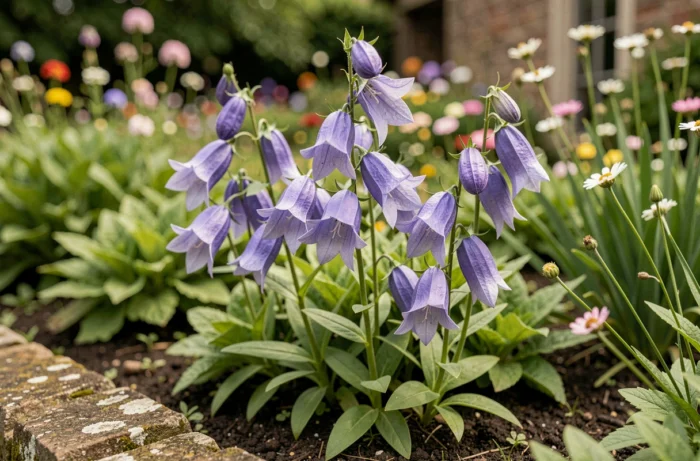
Rapunzel actually refers to several botanical genera with very different silhouettes: Campanula rapunculus with its purple bells, Phyteuma with its compact, claw-like spikes, or the reseda rapunzel (Reseda phyteuma) with its subtle fragrance. Comparing these plants based on measurable criteria (height, flowering period, soil type, culinary use) allows for the selection of the one that suits a flowerbed, border, or ornamental vegetable garden.
Comparative table of the main garden rapunzels
The three genera grouped under the common name “rapunzel” show notable differences in terms of growth habit, flowering, and cultivation conditions. The table below summarizes the characteristics derived from available botanical sheets.
| Criterion | Rapunzel bellflower (Campanula rapunculus) | Spike rapunzel (Phyteuma spicatum) | Reseda rapunzel (Reseda phyteuma) |
|---|---|---|---|
| Family | Campanulaceae | Campanulaceae | Resedaceae |
| Height | 40 to 80 cm | 30 to 60 cm | 20 to 40 cm |
| Flowering | Summer (June-August) | Late spring (May-June) | Spring-summer |
| Color | Blue-purple, sometimes white | Creamy white to bluish | Pale yellow-green |
| Exposure | Sun or partial shade | Partial shade to shade | Sun |
| Soil | Loose, deep, rich in humus | Fresh, humiferous, forested | Dry, calcareous, draining |
| Edible | Leaves and roots | Leaves and young shoots | No (fragrant interest) |
| Type | Perennial (often biennial in cultivation) | Perennial | Annual to biennial |
What stands out first is the difference in exposure. The rapunzel bellflower tolerates a wide light spectrum, while Phyteuma spicatum clearly prefers forest shade. For a garden facing full south, the reseda rapunzel or the bellflower will be more suitable.
Those looking to delve deeper into the subject can consult the detailed sheets of rapunzel flowers on Jardiniers info, which also cover closely related ornamental varieties.
Rapunzel bellflower in the ornamental vegetable garden: a plant with dual purpose
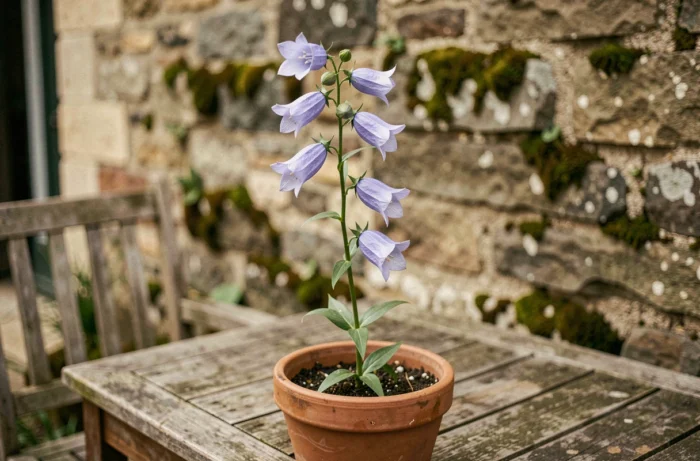
The rapunzel bellflower (Campanula rapunculus) was commonly cultivated in the 17th century before falling into obscurity. Its return to gardens is due to a trend that goes beyond mere decoration: the ornamental vegetable garden, where each plant is both beautiful and useful.
The fleshy roots are harvested in autumn and winter. They can be eaten raw, grated in salads, with a sweet flavor reminiscent of hazelnuts. The leaves can be picked almost all year round.
Conditions for success for the bellflower
Sowing is done in spring or autumn, on the surface, as the seeds need light to germinate. The recommended planting distance is about 20 cm. A loose, deep soil promotes the development of the taproot, which is important for both harvest and floral vigor.
- Soil rich in humus, worked deeply for at least 25 cm to allow the root to elongate without obstacles
- Regular watering in the first year, then moderate once the plant is established, as the rapunzel bellflower tolerates some drought
- Partial shade exposure in southern regions to avoid summer water stress, full sun in the north
In terms of pests, slugs represent the main threat to young plants. Aphids can colonize the flower spikes in early summer, but the damage is generally limited.
Spike rapunzel and naturalistic prairie scenes
Phyteuma spicatum produces white or bluish spikes with an atypical shape: the petals gradually open to form a sort of open cage. This mechanism favors cross-pollination by insects, which must force their way into the flower to access the nectar.
This unique floral architecture distinguishes the spike rapunzel from any other woodland perennial. The curved petals create a graphic effect that contrasts with the rounded silhouettes of perennial geraniums or astrantias often planted in the same locations.
Integration into a shaded flowerbed
The spike rapunzel thrives in fresh, humiferous soils typical of forest edges. However, it does not tolerate compacted soils or those saturated with standing water. It pairs well with ferns, foxgloves, and wood anemones to create a naturalistic prairie scene under tree cover.
Where the rapunzel bellflower offers summer flowering, Phyteuma blooms as early as May, covering spring in a mixed flowering calendar. Combining the two in a semi-shaded garden provides floral presence for four to five consecutive months.
Reseda rapunzel and the fragrant garden: an underutilized angle
The reseda rapunzel (Reseda phyteuma) shares only its common name with the other rapunzels. Its small yellow-green flowers do not visually compete with the bells of the bellflower. Its interest lies elsewhere: the fragrance, subtle but persistent, which intensifies in the evening.
This characteristic makes it a logical candidate for terrace borders or window edges, where one enjoys the garden in the evening. Paired with lavenders, heliotropes, or ornamental tobaccos, the reseda rapunzel completes an olfactory palette without competing with other plants visually.
It requires a calcareous and well-drained soil, in direct contrast to the spike rapunzel. This contrast in needs explains why the two plants are never found in the same flowerbed.
Wild rapunzel harvesting: a regulatory framework to know
Rapunzels grow naturally in meadows, slopes, and underbrush in many regions of France. Harvesting wild plants to install in the garden or consume in salads is not a trivial act.
National and prefectural rules govern the collection of plants in the wild according to a principle similar to that applied to mushrooms: tolerance for family harvesting, but quantities limited to 5 liters per person per day in state forests. On private land, collection without the owner’s consent is prohibited.
To enrich a garden with rapunzels, sowing remains the simplest and most respectful way towards wild populations, especially since seeds of rapunzel bellflower are easily found with specialized seed suppliers of heirloom plants.
The choice between bellflower, Phyteuma, and reseda rapunzel ultimately depends on three variables: the level of sunlight in the targeted flowerbed, the nature of the soil, and the desired use (ornamental, culinary, or fragrant). A garden that accommodates all three covers both spring and summer, sun and shade, table and nose.