The EAT8 gearbox (Efficient Automatic Transmission 8 speeds) is an automatic transmission designed by the Japanese manufacturer Aisin and widely adopted by the Stellantis group. It has equipped models from Peugeot, Citroën, DS, and Opel for several years. Despite a generally recognized reliability, this gearbox develops specific failures whose causes are often poorly understood by the concerned owners.
EAT8 “lifetime” oil: the technical misunderstanding that accelerates wear
The starting point for most EAT8 malfunctions is not a design flaw, but a gap between manufacturer communication and mechanical reality. Some marketing documents still present the gearbox’s ATF fluid as “filled for life,” suggesting that no fluid change is necessary throughout the vehicle’s lifespan.
Automatic transmission specialists dispute this claim. An ATF change is recommended between 60,000 and 80,000 km to preserve the hydraulic block and limit the clogging of solenoids. Beyond this threshold without replacement, the fluid loses its lubrication and cooling properties, leading to a cascade of progressive symptoms.
Understanding EAT8 automatic gearbox issues starts with this distinction between the “maintenance-free” theory and the actual workshop practice. An urban vehicle, subjected to frequent stop-and-go cycles, puts much more strain on the fluid than a vehicle primarily driven on the highway.
EAT8 symptoms: from slight jolts to complete failure
Recent field reports show that EAT8 issues rarely manifest as a sudden failure. The symptoms appear progressively, complicating diagnosis for an unsuspecting driver.
Initial phase: hesitations and jolts when cold
The first sign is a noticeable hesitation between first and third gear, especially during cold starts. The gearbox seems to “search” for its gear for one to two seconds. This behavior diminishes when warm and often disappears after a few kilometers, leading many drivers to overlook it.
Intermediate phase: persistent jolts and slipping
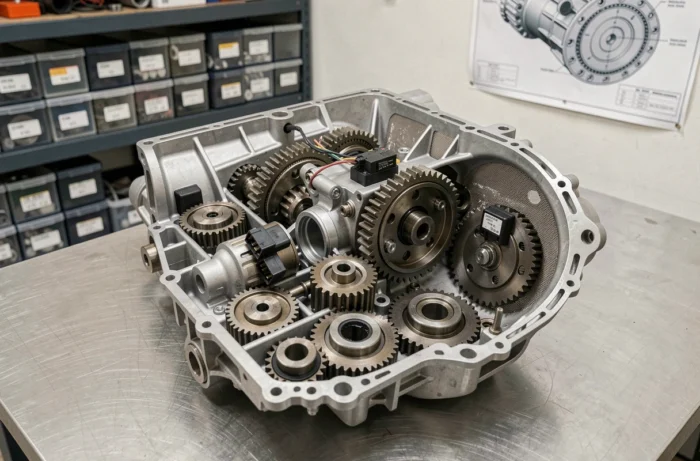
When the fluid continues to degrade or the solenoids become clogged, the jolts become regular even at operating temperature. Slipping occurs: the engine revs without power being transmitted to the wheels. At this stage, the torque converter (the hydraulic device located between the engine and the gearbox) undergoes accelerated wear.
Critical phase: degraded mode and dashboard warning lights
The gearbox’s computer detects out-of-tolerance values and switches to degraded mode. The vehicle remains stuck in one or two gears, the transmission warning light comes on, and an error message may display. At this level, a simple fluid change is no longer sufficient.
Severe use and EAT8 gearbox: conditions that accelerate failures
A rarely addressed angle concerns the notion of severe use applied to the automatic transmission. Not all drivers stress the EAT8 gearbox in the same way, and maintenance intervals should vary accordingly.
- Dense urban traffic imposes constant clutch engagement-disengagement cycles between the first two gears, which overheats the fluid and accelerates the wear of the internal clutch discs.
- Driving in mountainous areas or with a trailer increases the operating temperature of the gearbox. The torque converter operates under high load, degrading the ATF fluid much faster than in standard road use.
- Repeated short trips prevent the gearbox from reaching its optimal temperature. The fluid accumulates condensation and impurities without ever being purged by prolonged hot operation.
Under these conditions, specialists suggest reducing the fluid change interval to around 40,000 km. The “maintenance-free” label does not hold up against intensive use, and this reality explains why some vehicles develop symptoms as early as 50,000 km while others run without issues well beyond that.

Stellantis recalls and EAT8 gearbox: what the campaigns really cover
Stellantis has significantly ramped up its recall campaigns in recent years, increasing from about 7.3 million vehicles recalled in 2024 to approximately 13.4 million in 2025. This dramatic rise fuels frequent confusion among owners.
Recent recalls mainly concern software and electronic safety defects, not directly related to the internal mechanics of the EAT8 gearbox. The 2026 campaigns, for example, involve malfunctions of rearview cameras or electronic bugs, not the transmission block itself.
This distinction has a direct practical consequence: an owner facing jolts or slipping cannot rely on a manufacturer recall to cover the repair. The replacement of solenoids, fluid changes, or reprogramming of the computer generally remains the owner’s responsibility, unless a contractual warranty is still active.
EAT8 repair: hierarchy of interventions by severity level
When facing a malfunction, the right approach is to follow a logical order of intervention rather than randomly replacing components.
- A complete ATF fluid change with filter replacement resolves most cases of light jolts and cold hesitations. It is the least expensive and most effective preventive intervention.
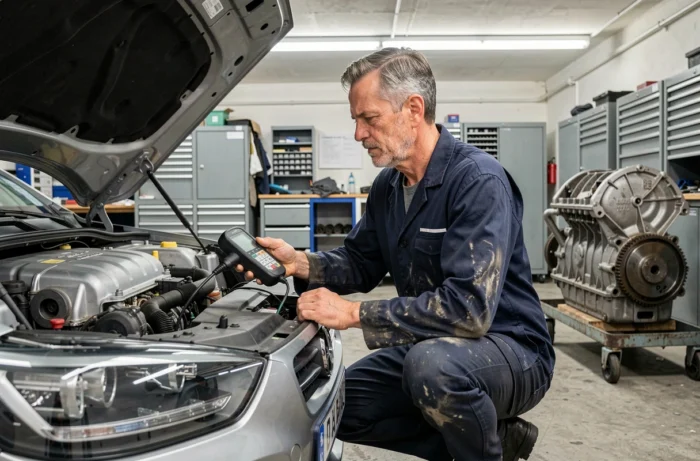
- Dedicated electronic diagnostics allow reading the fault codes from the gearbox computer and precisely identifying a faulty solenoid or out-of-range sensor. Without this diagnosis, any repair is based on guesswork.
- Reprogramming the computer corrects mapping offsets that cause inappropriate gear shifts. Stellantis regularly publishes software updates for its gearboxes.
- Replacing solenoids or the torque converter only occurs when the previous steps have yielded no results. These interventions represent a significantly higher cost.
The EAT8 gearbox remains a generally robust transmission whose longevity directly depends on the quality of its maintenance. Adjusting the fluid change frequency to driving style, not ignoring the first signs of hesitation, and having an electronic diagnosis performed as soon as persistent jolts appear are three concrete levers to avoid a hefty bill.