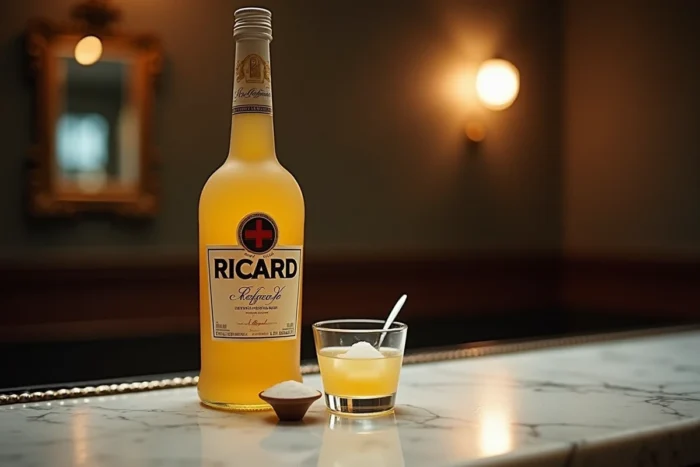
A glass of Ricard served with fresh water contains an alcohol content easily identifiable on the label. The sugar content, however, remains more discreet. How many carbohydrates does a serving of pastis from Marseille actually provide, and where does this sugar come from in the recipe? The available nutritional data allows for precise figures and comparisons of Ricard with other common alcoholic beverages.
Nutritional profile of Ricard per 100 ml: carbohydrates, alcohol, and calories
The product sheets referenced on Open Food Facts and public nutritional databases provide a detailed profile of Ricard pastis from Marseille. The table below compiles the values for 100 ml of pure product, before dilution.
| Nutrient | Ricard (per 100 ml) | Average liqueurs and spirits (per 100 ml) |
|---|---|---|
| Calories | 274 kcal | Variable depending on degree |
| Total carbohydrates | 2.8 g | 5.6 g |
| of which sugars | 2.3 g | 3.8 g |
| Proteins | 0.0 g | 0.0 g |
| Fats | 0.0 g | 0.1 g |
| Alcohol | 38 g | 30 g |
| Water | 60 g | 64 g |
2.3 g of sugars per 100 ml of pure pastis: this figure seems modest compared to a soda or fruit juice. Almost all of the caloric intake comes from the alcohol itself, which is at 45°.
It is noted that Ricard has significantly lower carbohydrates than the average in the “liqueurs and spirits” category. With 2.8 g of total carbohydrates compared to an average of 5.6 g, pastis is situated in the lower half of the spectrum of sweet spirits. The difference is partly explained by the nature of the product: a pastis is not a fruit liqueur or a cream, whose recipes incorporate much higher amounts of sugar.
An article detailing the composition and sugar content in Ricard related to a standard glass helps visualize what this content represents once the dose is diluted in water.
Sugar and regulation of pastis from Marseille: a threshold imposed by law
Regulation (EU) 2019/787, applicable since 2021, strictly governs the definition of spirits in Europe. To bear the mention “pastis,” a beverage must meet several criteria, including a minimum sugar content expressed in grams per liter of inverted sugar. This regulatory constraint distinguishes pastis from a simple “aniseed spirit drink,” a broader and less regulated category.
In practice, Ricard cannot freely reduce the amount of sugar in its recipe without risking losing the designation “Pastis de Marseille.” Sugar plays a precise technical role in the product.
- It softens the natural bitterness of licorice and star anise, the two central aromatic ingredients of Ricard.
- It contributes to the mouthfeel and the louche effect (the white opacity that appears upon contact with water), interacting with anethole, the main aromatic molecule.
- It stabilizes the flavor balance between the strength of the 45° alcohol and the herbal notes from the infused plants.
This regulatory framework explains why all pastis on the market contains added sugar. The composition of Ricard also mentions the following ingredients: alcohol, water, star anise extract, licorice extract, sugar, and aromatic plants. Nothing more.
Calories in Ricard: sugar has little weight compared to alcohol
Of the 274 kcal for 100 ml of pure pastis, the portion attributable to sugars is marginal. One gram of sugar provides about 4 kcal. With 2.3 g of sugars, you get about ten kilocalories out of a total largely dominated by alcohol.
Alcohol provides 7 kcal per gram. With 38 g of alcohol per 100 ml, the calculation is quick: alcohol accounts for over 95% of the calories in a glass of Ricard. Sugar, despite its presence in the recipe, is not the main contributor to the caloric load.

This distribution distinguishes pastis from many ready-to-drink alcoholic beverages or sweet cocktails, where added sugar (syrups, juices, sodas) can account for half of the total caloric intake. A Ricard served with still water remains, from a strictly carbohydrate perspective, one of the least sweet options among common aperitifs.
Taxation and the real cost of sugar in a bottle
A rarely discussed angle concerns the price structure of a bottle of Ricard. Estimates from public debates on the taxation of spirits in France suggest that the majority of the selling price corresponds to taxes (excise on alcohol and VAT). The value of raw materials, including sugar and flavors, weighs relatively little in the final price paid by the consumer.
The sugar in Ricard thus has primarily organoleptic and regulatory roles. Its economic cost in the bottle is negligible compared to the taxation related to the alcohol content.
Vitamins and minerals in pastis: a null contribution
The nutritional data for pure pastis shows a complete absence of vitamins (A, C, D, E, K) and insignificant mineral content. Ricard provides no measurable micronutrient. This is a constant among pure spirits: the distillation and maceration processes do not preserve any vitamins that may be present in the original plants.
This finding is not surprising, but it deserves to be clearly stated in light of marketing claims that sometimes highlight the “natural ingredients” (anise, licorice) of a pastis. Natural, indeed, but their nutritional contribution in the finished product is null beyond the aroma.
Ricard pastis from Marseille therefore contains 2.3 g of sugars per 100 ml, a level regulated by European legislation and lower than the average of liqueurs. Almost all of its calories come from alcohol, not sugar. For a consumer monitoring their carbohydrate intake, it is ethanol, not sucrose, that weighs in the energy balance of an aniseed aperitif.