
In France, the demand for social housing concerns several million households, and the processing of applications still largely relies on lengthy manual procedures. Artificial intelligence applied to social housing refers to the set of technologies (natural language processing, machine learning, conversational agents) used to accelerate the processing of applications, guide applicants, or assist landlords in managing their properties.
Scoring Applications and Tenant-Housing Matching by AI
The processing of a social housing application involves a scoring step: each file receives a score based on regulatory criteria (income, family composition, length of the application, housing situation). Traditionally, this scoring involves caseworkers who manually cross-reference the declared data with supporting documents.
AI tools now allow for part of this work to be automated. A matching algorithm compares the applicant’s profile to the characteristics of the available housing stock (size, location, accessibility, residual rent after APL) to propose relevant matches. The benefits include faster processing and reduced data entry errors.
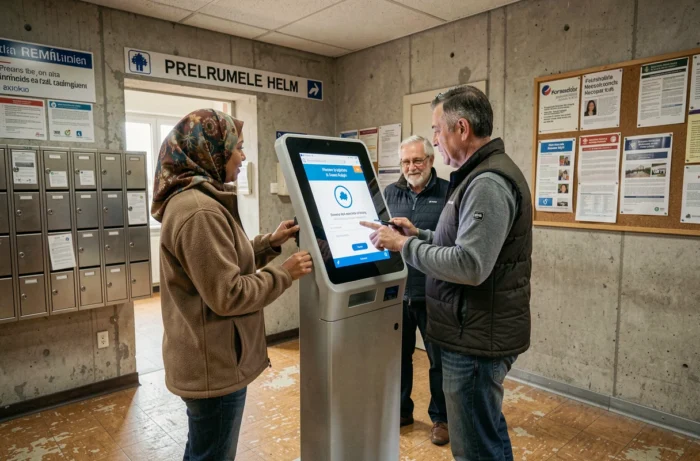
As detailed by the housing robot on Actu Web, some conversational systems guide the applicant from the moment they create their file, verify the completeness of the documents, and answer frequently asked questions without human intervention. This type of agent reduces the number of incoming calls to landlords’ reception services.
The matching remains a decision-support tool. The allocation committee retains the power to decide, and the algorithm merely ranks proposals. This distinction has become legally significant with the enforcement of the European regulation on AI.

AI Act and Social Housing: Regulatory Obligations Since 2026
Since August 2026, the European regulation on artificial intelligence (AI Act) has entered its phase of general application. AI systems used for access to social benefits or services such as housing are classified as “high risk.”
This classification entails specific obligations for landlords and software publishers:
- Transparency: the applicant must be informed that an AI system is involved in processing their file, and the criteria used must be documented.
- Effective human oversight: no allocation decision can rely solely on an algorithm without a qualified agent being able to verify, modify, or contradict it.
- Auditability: models must maintain a usable history to retrospectively check for the absence of discriminatory biases (origin, disability, family situation).
- Right to contest: an applicant who believes that the algorithmic score is unfavorable can demand a human review of their situation.
In practice, a landlord can no longer rely on an opaque score generated by a model to reject or defer an application. This constraint pushes organizations to document their algorithms and train their teams to interpret the results produced by AI.
Consequences for Property Management Software Publishers
ERP publishers (integrated management software) used in social housing must integrate these requirements from the design stage. This means detailed audit logs, interfaces that allow the agent to understand why a particular housing unit was proposed to a specific applicant, and the ability to deactivate automatic recommendations at any time.
AI-Assisted Management of Social Real Estate
Beyond access to housing, artificial intelligence is transforming the ongoing management of the housing stock. Landlords collect massive data through their business tools: contractual data, maintenance histories, sensor readings on technical equipment.
Predictive maintenance is the most mature use case. Sensors installed on boilers, elevators, or ventilation systems transmit real-time data. A machine learning model detects anomalies before breakdowns, reducing emergency interventions and improving service quality for tenants.
Automated extraction of documentary data represents another lever. Landlords manage considerable volumes of documents: leases, technical diagnostics, meeting minutes, plans. Optical recognition tools combined with natural language processing allow for indexing and classifying these documents, then extracting useful information (due dates, amounts, areas) without manual re-entry.
Concrete Limits and Algorithmic Biases in Social Housing
AI is not neutral. A model trained on historical allocation data can reproduce, or even amplify, existing biases. If a neighborhood has historically accommodated a particular sociodemographic profile, the algorithm risks perpetuating this distribution instead of correcting it.
The quality of data determines the reliability of any AI system. However, in social housing, databases are often heterogeneous, incomplete, or poorly structured. An aging ERP, approximate manual entries, or undetected duplicates directly degrade the model’s results.
The issue of acceptability by agents is equally critical. A powerful but opaque tool will be circumvented. Field feedback shows that adoption requires training teams and interfaces that clearly explain the recommendation made by the machine, rather than presenting it as a verdict.
Access to social housing remains a decision with a significant human impact. AI plays a role as an accelerator and filter, not as a decision-maker. Landlords deploying these technologies gain efficiency as long as they maintain rigorous oversight, documentation of criteria, and the ability for human intervention at every stage of the process.