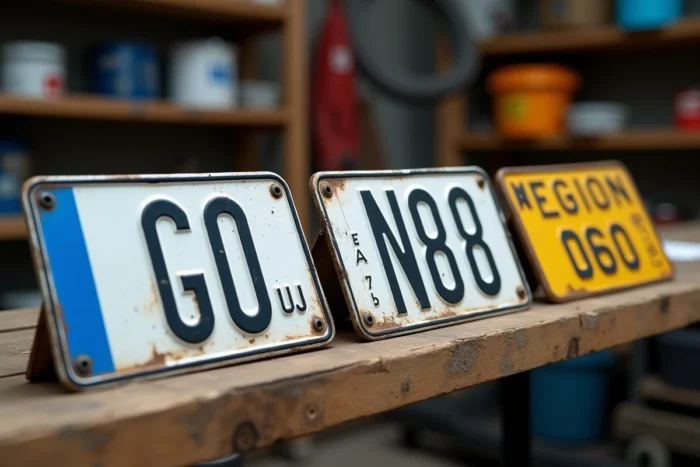
European license plates share a misleading family resemblance. Blue euroband, alphanumeric combination, similar dimensions: at first glance, the system seems unified. However, each state maintains its own format, coding, and regulatory practices. Understanding these discrepancies allows one to read a foreign plate at first glance, but also to gauge how much national systems diverge on concrete points.
License Plate Formats in Europe: Dimensions and Combinations Compared
| Country | Code | Typical Format | Notable Feature |
|---|---|---|---|
| France | F | AA-123-AA | SIV system since 2009, regional identifier of choice |
| Germany | D | XX-AB 1234 | Prefix linked to the registration district |
| Netherlands | NL | GBB-01-B (Sidecode 11) | New format in effect since June 2024 |
| United Kingdom | UK | AB12 CDE | UK code replaces GB since 2021 (post-Brexit) |
| Italy | I | AB 123 CD | Plate linked to the vehicle, non-transferable |
| Belgium | B | 1-ABC-234 | Plate linked to the owner, transferable between vehicles |
| Spain | E | 1234 BCD | No geographical indication since 2000 |
This table highlights a often underestimated point: the logic of allocation varies as much as the format itself. Belgium ties the plate to the person, while France and Italy tie it to the vehicle. This choice has direct consequences during resale or cross-border transfer.
To delve deeper into the differences between national codes and understand how to identify foreign license plates in Europe, the code displayed on the euroband remains the most reliable reference.
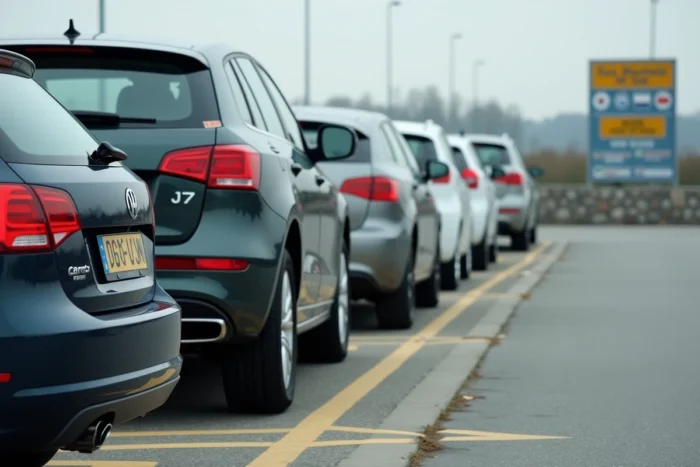
Euroband and Country Code: What the Blue Band Reveals
The euroband is the vertical blue band on the left side of the plate, displaying the European flag (twelve stars) and the country code in white letters. Most EU member states use it, but its content varies by country.
Some codes are intuitive: F for France, D for Germany (Deutschland), E for Spain (España). Others can be confusing.
- L designates Luxembourg, not Latvia (which uses LV)
- CZ corresponds to the Czech Republic, BG to Bulgaria, HR to Croatia
- CH identifies Switzerland (Confoederatio Helvetica), a non-EU country that does not display the euroband but a distinct white oval
- The United Kingdom now uses the UK code instead of GB, an official change that took effect after Brexit
The euroband is not just a visual marker. In countries that have adopted the digital motorway vignette, the plate registered online replaces the physical sticker affixed to the windshield. Austria, the Czech Republic, Slovenia, Hungary, and Switzerland operate this way.
Toll and Automatic Plate Reading
France, Spain, and Italy maintain a barrier toll system. In contrast, several Central and Northern European countries rely on “free flow,” a barrier-free toll system that depends on automatic plate reading by camera. For a foreign driver, this means a prior registration of their plate number on the portal of the country being crossed, under penalty of a fine.
Foreign Plates in France: Obligation to Re-register
A vehicle registered abroad can circulate in France temporarily. Beyond a period set by regulation (linked to establishing primary residence in the territory), the owner must request a French registration certificate and obtain a plate in SIV format.
The SIV format (Vehicle Registration System) assigns a lifetime number to the vehicle, composed of two letters, three digits, and two letters. The regional identifier displayed on the right side of the plate is chosen by the owner and has no administrative value.
Points of Caution for an Imported Vehicle
The re-registration procedure requires providing the European conformity certificate of the vehicle, a valid technical inspection certificate, and the foreign title. The absence of a conformity certificate blocks the process and requires a request to the manufacturer or an identification certificate issued by the DREAL.
The physical format of the plate must comply with French standards: white background at the front, white background also at the rear (the yellow rear background was abandoned with the transition to SIV). Plates must be approved and bear a manufacturer’s identifier.

Evolution of Plate Formats: The Netherlands Leading the Way
The Netherlands illustrates how dynamic registration systems remain. The country is on its eleventh coding scheme (Sidecode 11), adopted in June 2024 for light vehicles. This pace of change reflects the growth of the vehicle fleet and the gradual exhaustion of available combinations in each format.
Most other European countries have not needed to modify their format as frequently. The French SIV system, for example, offers a sufficient volume of combinations for several decades. Germany, with its geographical district prefix, also has a wide reserve thanks to the variety of existing prefixes.
The color of the plates is another national marker. Dutch plates feature a characteristic yellow background at the rear. Belgium uses a red background for certain categories of vehicles (commercial plates). Luxembourg displays a yellow background. These chromatic variations often allow for identifying a country even before reading the code on the euroband.
European harmonization has unified the general appearance of plates without erasing national particularities. The physical format, the logic of allocation, the link between plate and owner or vehicle, and the integration into digital toll systems remain sovereign choices. It is this layering of a common framework and local rules that makes reading foreign plates both accessible and rich in details for those who take the time to observe them.