
Olfactory matching lists have multiplied in recent years, driven by dupe brands and online recommendation platforms. Their promise: to start from a fragrance you already love to identify others with similar profiles. The principle seems simple, but the reliability of these lists varies considerably depending on the classification method used, the size of the database, and the consideration of skin chemistry.
What an olfactory matching list reveals (and masks)
A matching list classifies fragrances by compositional proximity. It usually features a reference fragrance, followed by several alternatives sharing common notes, often base and heart notes. The problem is that two fragrances may share vanilla and sandalwood on paper while producing a radically different trail on the skin.
The reason lies in what the lists do not measure: the exact dosage of each note, the quality of raw materials (synthetic or natural), and especially the interaction with skin pH. Therefore, a match on a list remains a starting point, not a verdict.
The most useful lists are those that specify the olfactory family (oriental, woody, floral, citrus) and the type of concentration (eau de toilette, eau de parfum). Without these two pieces of information, the comparison loses much of its relevance. To find your signature fragrance, you should read these lists as a map, not as a destination.
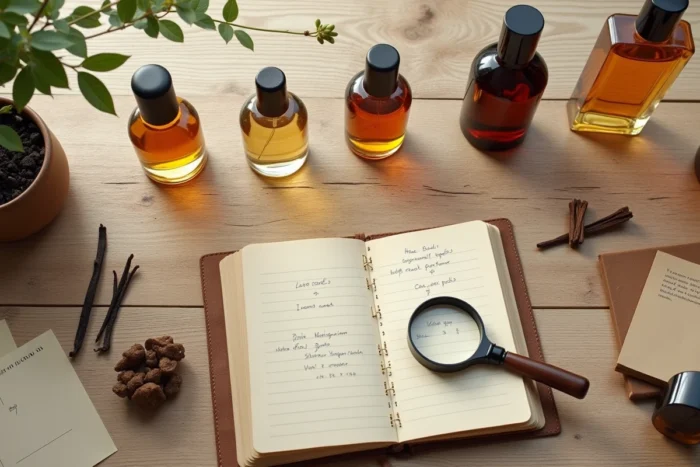
Olfactory families and personal profile: the filter that lists do not provide
Most guides advise “discovering olfactory families.” The advice is correct but insufficient. Knowing that you like orientals does not tell you whether you prefer a dry amber oriental or a sweet gourmand oriental. Granularity matters.
Before using a matching list, it is more effective to create your own olfactory profile by identifying three elements:
- The base notes that persist on your skin after several hours (musk, amber, cedar, patchouli), as they define the actual trail
- The types of scents you wear spontaneously outside of any conscious search, which reflect your natural olfactory personality
- The contexts in which you wear perfume (office, evening, daily), as projection and longevity do not meet the same requirements
This profile acts as a filter. When applied to a matching list, it allows for quickly eliminating suggestions that share appealing top notes but whose base does not match your skin.
AI matching and visual recommendation: the new tools
Static lists (PDFs, brand charts) are no longer the only available format. Specialized platforms like Scento use algorithms capable of processing over 15,000 fragrances and 1,000 unique notes to generate dynamic matches. These systems refine with user feedback, improving accuracy over time.
Jo Malone London has taken a different angle by offering to analyze Pinterest boards (colors, landscapes, textures) to translate a visual universe into an olfactory profile. This approach bypasses a classic obstacle: many people cannot name what they like to smell, but they know very well what visually attracts them.
However, these tools remain pre-selection filters. No algorithm can simulate the chemical reaction between a fragrance and your skin. Field feedback varies on this point: some users find very accurate matches from the first suggestion, while others notice a clear gap between the recommendation and the result worn.
Testing smartly after the list
The transition from list to bottle remains the decisive step. Rather than ordering a full bottle based on a match, decants (small formats of a few milliliters) allow you to wear a fragrance for several days in real conditions.
A fragrance must be evaluated over at least three days to judge its evolution on your skin. On the first day, you primarily perceive the top notes. On the second, the heart settles in. On the third, you can evaluate the base and decide whether this trail represents you or not.
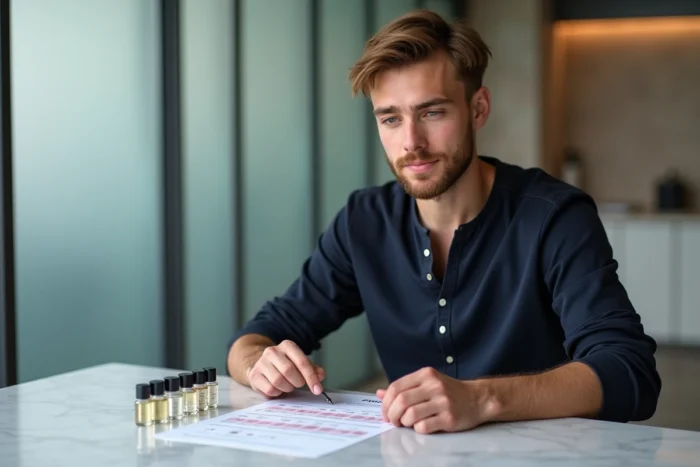
Building your olfactory signature without multiplying mistakes
The temptation when faced with a matching list is to try everything. This is counterproductive. The nose saturates quickly, and beyond three or four fragrances tested in the same day, the ability to distinguish collapses.
A more reliable method is to proceed by gradual elimination:
- Select three to five fragrances from the list, prioritizing those whose olfactory family and concentration match your profile
- Test them on skin (wrist, inside of elbow) at a rate of one per day, noting your impressions at three moments: application, midday, end of day
- Eliminate those whose base you dislike, even if the top notes had seduced you
- Reassess the finalists in a second week of testing to confirm under different conditions (heat, humidity, physical activity)
This approach requires patience but avoids impulsive purchases. The signature fragrance is not the one that pleases upon opening the bottle, it is the one that remains pleasant after hours on your skin, in your daily life.
Olfactory matching lists are a navigation tool, not a decision-making one. They narrow down the possibilities, guide towards families consistent with your tastes, and allow you to discover alternatives you might not have spotted alone. The rest plays out on the skin, over time, with a rested nose and a notebook.