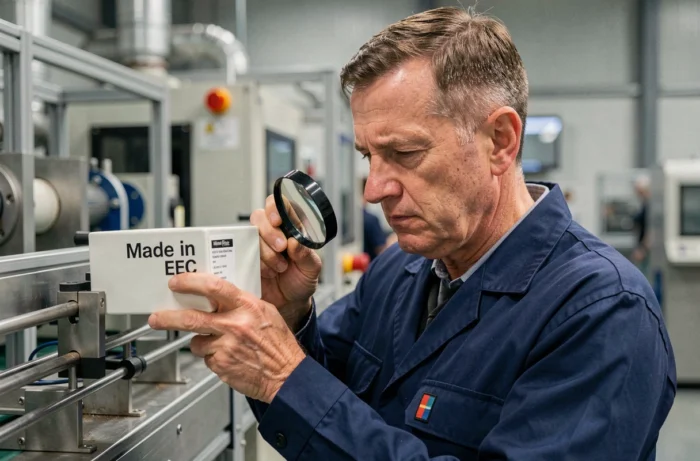
The label “Made in EEC” still appears on some products in circulation, particularly in the second-hand market and old stock. It refers to the European Economic Community, an institutional entity that ceased to exist in this form in the early 1990s. Understanding what this label entails requires distinguishing between voluntary commercial marking and what falls under a genuine binding legal framework.
Origin marking in Europe: what the law actually provides
The first reflex when encountering a product stamped “Made in EEC” is to attribute it an official certification value. However, the non-preferential origin rules of the Union Customs Code frame these labels quite differently. Origin marking remains optional for most manufactured goods marketed within the European Union.
In practice, affixing “Made in EEC,” “Made in EU,” or “Made in France” to a product is a voluntary action by the manufacturer or importer. The only obligation concerns the truthfulness of the label: it must be justifiable according to the origin rules, meaning that the product was entirely obtained in the relevant area, or that it underwent its last substantial transformation there.
Those seeking to understand what made in eec means often discover that this term has never had an autonomous legal status in community law. It functioned as a commercial geographical indication, not as a label governed by a specific set of requirements.
| Label | Legal Status | Dedicated Control Body | Mandatory Character |
|---|---|---|---|
| Made in EEC | Self-declared commercial term | None | No |
| Made in EU | Self-declared commercial term | None | No |
| Made in France | Label governed by the Customs Code | Customs (post-control) | No |
| CE Marking | Declaration of regulatory compliance | Market surveillance authorities | Yes (for certain categories) |
This table highlights a clear gap between common perception and regulatory reality. The CE marking, on the other hand, corresponds to a legal obligation for specific product categories (toys, electrical equipment, medical devices). “Made in EEC” has never reached this level of regulatory requirement.

From the EEC to the European Union: why the label has disappeared from tags
The European Economic Community, created by the Treaty of Rome, was absorbed into the institutional structure of the European Union with the Maastricht Treaty, which came into force in November 1993. From that date, the reference to “EEC” (or “CEE” in French) lost its institutional relevance.
Manufacturers gradually replaced “Made in EEC” with “Made in EU” or national labels. A product bearing the label “Made in EEC” almost always dates from before 1994. This information is of direct interest to collectors, vintage buyers, and professionals in the second-hand market.
However, some dormant stocks or products with a very long lifespan (tools, tableware, industrial parts) still circulate with this label. Its presence does not render the product non-compliant, but it indicates an older manufacturing date, which may have implications for the safety standards applicable at the time of initial market release.
Customs controls and misleading origin labels
The recent trend in origin marking is towards strengthening controls. French customs, authorized by the Consumer Code (articles L. 132-1 and following of the Consumer Code, referenced on Légifrance), can sanction the use of a misleading origin label. The notion of misleading covers cases where a product manufactured outside the Union bears a label suggesting European manufacturing.
- A product assembled in Asia from European components cannot legitimately bear “Made in EEC” or “Made in EU” if the last substantial transformation took place outside the area.
- The absence of an official “Made in EEC” label means that no body issues this label: it is the manufacturer itself who decides to affix it, under its own responsibility.
- Sanctions for the abusive use of an origin label fall under consumer law and may include fines, product withdrawal, or prosecution for misleading commercial practices.
The strengthening of customs controls also concerns online sales platforms, where product traceability remains a weak point. A seller marketing a recent item under the label “Made in EEC” exposes themselves to checks, as this term suggests a manufacturing date prior to the disappearance of the EEC.
Label “Made in EEC” in the second-hand market: an indicator of era or a commercial argument
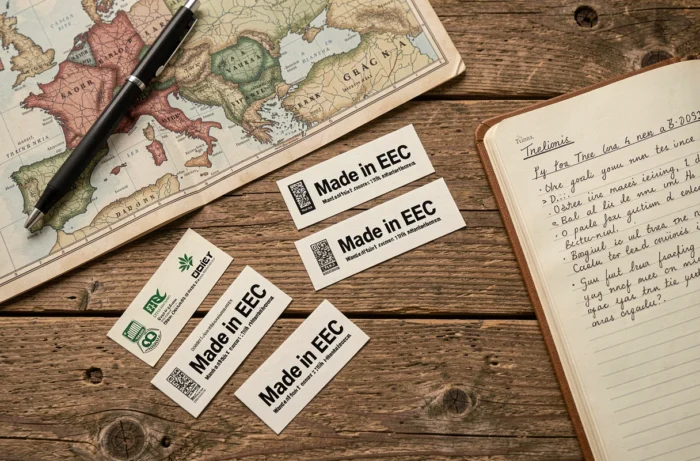
In flea markets, resale sites, and auctions, the label “Made in EEC” functions as a chronological marker. It allows for an approximate dating of an object and authenticates its manufacturing period. For certain categories (vintage toys, small appliances, automotive accessories), this label serves as a more reliable dating indicator than a serial number.
Specialized sellers sometimes use it as an argument for rarity or supposed quality. The logic is based on the idea that European manufacturing standards of the 1970s-1980s guaranteed a certain robustness. This perception remains subjective and is not based on any systematic normative comparison between the standards of the time and those in force today.
The gap between perceived value and legal reality remains the thread running through this label. “Made in EEC” has never been a quality label, but a voluntary geographical indication whose commercial scope has largely survived its institutional relevance. Buyers benefit from checking the applicable safety standards for the product rather than relying on a label whose framework disappeared more than thirty years ago.