
Two cats, one litter box, and underlying tensions around access to the toilet: the scenario concerns a notable proportion of multi-cat households. The question of how many litter boxes for two cats seems simple, but the answer depends less on a formula than on how resources are distributed in space.
Aligned boxes or dispersed boxes: what recent recommendations measure
Most online guides stop at the so-called “n+1” rule: for two cats, three litter boxes. This number remains a useful benchmark, but the revised AAFP/ISFM joint guidelines from 2022-2023 clarify a point often overlooked.
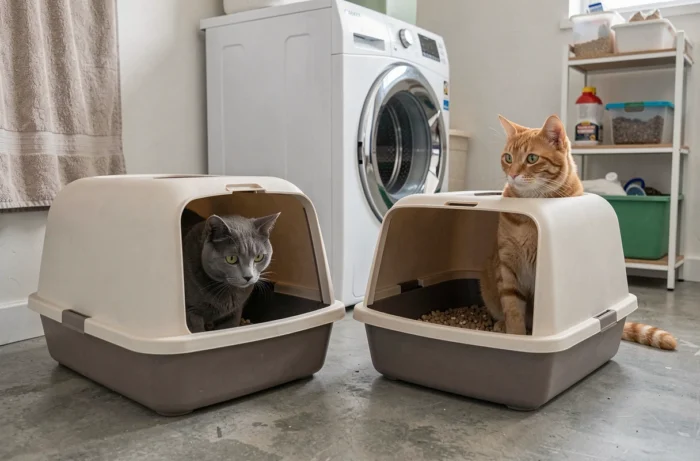
Multiple boxes aligned in the same room function as a single station in the eyes of the cats. In other words, three boxes side by side in the laundry room do not offer three distinct options. For socially less affiliated cats, the recommendations speak of distinct grooming sites, spread across separate areas of the home.
Before choosing a litter box for 2 cats, it is essential to assess the layout of the home as much as the number of boxes.
| Configuration | Number of boxes | Spatial distribution | Reduction of access conflicts |
|---|---|---|---|
| One box, one room | 1 | None | Low |
| Three boxes, same room | 3 | None (perceived as a single station) | Limited |
| Two boxes, two different rooms | 2 | Two distinct areas | Moderate |
| Three boxes, three areas of the home | 3 | Three distinct areas | Suitable |
The table shows: the dispersion of boxes matters more than their raw number. A household with two well-placed boxes in distant rooms can offer better comfort than a household with three boxes clustered in the basement.
Inappropriate elimination in cats: the number of boxes does not explain everything
A study published in August 2026 by Hartpury University confirms what behaviorists observe in consultations. Litter box accidents in multi-cat households are a multifactorial issue, where the number of boxes is just one parameter among others.
The authors identify several interacting factors:
- The size of the box relative to the cat’s size: a box that is too small causes some individuals to eliminate next to it or elsewhere in the house.
- The cleanliness of the substrate: two cats saturate a box faster, and the more demanding cat stops using it first.
- The ability to avoid a perceived threatening conspecific: if the only path to the box passes through the territory of the dominant cat, the second cat holds back or finds another spot.
Adding a third box does not solve anything if that box is placed in a dead-end where the subordinate cat can be trapped. Access without possible ambush is as crucial a criterion as the quantity of litter.
Multi-level housing and small apartments: adapting the rule to the terrain
Practical guides published in 2026 emphasize a distinction rarely made in general content. In a multi-level home, the minimum recommendation is to place at least one box per floor inhabited by the cats. A cat that has to go down two flights of stairs to access its litter at night will eventually find a closer alternative.
On the other hand, in a studio or a one-bedroom apartment, three boxes pose a practical problem of clutter and odor management. The priority then becomes the maximum distance between available boxes.
Two boxes placed at opposite ends of the apartment (for example, bathroom and entrance) create two distinct elimination zones. Each cat has a fallback point. Two well-separated boxes in a small space are better than three cramped boxes.
Concrete placement criteria
An effective box meets three spatial conditions: it is away from the food bowl, it offers an exit in at least two directions (no dead-end corridors), and it remains accessible without having to cross the resting area of the other cat.
Regarding cleaning, the frequency of maintenance weighs as much as the number of boxes. A substrate removed twice a day in two well-placed boxes maintains a higher level of hygiene than three boxes cleaned every two days.

Silent conflicts between cats: signals to watch for around the box
A cat blocking access to the litter box does not always growl. The guarding behavior can sometimes be subtle: the dominant cat sleeps near the box, positions itself in the access corridor, or stares at the other cat as it approaches.
The consequences appear gradually. The ousted cat starts by holding back longer, then eliminates in a discreet spot (behind a piece of furniture, on a textile). Inappropriate elimination is often a symptom of an access conflict, not a lack of boxes.
Observing where each cat eliminates for a week provides reliable insight. If one of the two consistently uses the same box while the other alternates or avoids certain times, the spatial distribution deserves to be reviewed.
The number of litter boxes for two cats rarely boils down to a single figure. The n+1 rule provides a starting point, but the most telling data remains the distribution: separate elimination zones, accessible without forced crossing, in each part of the home occupied by the cats.