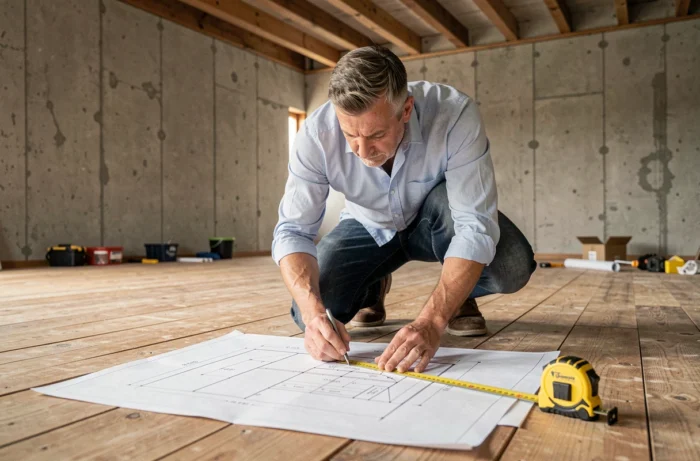
Calculating the area of a rectangular room takes thirty seconds. Calculating the area in m2 of a plot of land or a room with four sides of different lengths presents a different kind of problem. Without a reliable right angle, the school formulas no longer work, and the resulting approximation can have concrete consequences, especially during a real estate transaction subject to the Carrez law.
Why the formula length x width does not work on an irregular quadrilateral
The multiplication of length by width assumes a rectangle. As soon as the four sides differ, the shape is no longer a rectangle, nor even a parallelogram. Applying this formula amounts to ignoring the distortion of angles, which can lead to a sometimes significant area discrepancy.
The key point to remember: knowing the four sides is not enough to calculate the area. A quadrilateral can change shape (and thus area) while maintaining the same side lengths. An additional piece of information is needed, typically a diagonal or an angle.
Mastering the m2 calculation with 4 different sides requires understanding this geometric constraint before taking out the measuring tape.
Triangulation of any quadrilateral: the field method
The most reliable method, and the one that building and diagnostic professionals use in the field, is based on the decomposition of the quadrilateral into two triangles. The principle is straightforward: draw a diagonal from one vertex to the opposite vertex, creating two triangles whose areas can be calculated separately and then added together.

Measure the diagonal on-site
Take a decameter or a laser rangefinder. Measure the four sides, then measure the internal diagonal that connects two opposite vertices. Choose the one that remains inside the shape (in the case of a concave quadrilateral, only one of the two diagonals meets this condition).
Apply Heron’s formula to each triangle
Once the diagonal is known, each triangle is defined by three sides. Heron’s formula allows you to calculate the area of a triangle from its three sides, without needing to measure a height:
- Calculate the semi-perimeter s = (a + b + c) / 2, where a, b, and c are the three sides of the triangle
- Apply the formula: Area = square root of [s x (s – a) x (s – b) x (s – c)]
- Repeat the operation for the second triangle, then add the two areas
Heron’s formula does not require any angles or heights. This makes it suitable for field measurements, where assessing a perpendicular height or a precise angle is often complicated.
Subdivision into sub-figures: what real estate diagnosticians do
Diagnosticians and surveyors almost never attempt to apply a single formula to an irregular quadrilateral. The common practice is to break the area down into simple rectangles and triangles, measure each sub-figure, and then add the results.
This approach may seem less elegant than a global formula. However, it has two decisive advantages in the field.
The first is robustness against measurement errors. If one dimension is incorrect, the error remains confined to a sub-figure. With a global formula like Brahmagupta or Heron applied to the entire quadrilateral, a single erroneous measurement can skew the entire result.
The second advantage is auditability. A plan annotated with measured rectangles and triangles can be verified by a third party. A diagnostician who provides a Carrez measurement must be able to justify every declared square meter. A plan broken down into sub-figures is easier to verify than a global calculation.
Irregular area and the Carrez law: the consequences of a calculation error
Articles that discuss area calculation on four unequal sides often remain in the mathematical realm. The legal dimension deserves to be clearly stated.
In co-ownership, the private area declared during a sale must comply with the Carrez measurement. Recent case law strengthens the responsibility of the measurement professional when the error exceeds the tolerance threshold. Judges do not accept the argument of irregular shape to justify a discrepancy in area. A trapezoidal room or a living room with non-parallel walls does not exempt the measurer from providing an accurate result.
The consequences for the seller can be direct: if the buyer finds a surface deficit greater than the legal threshold, they can request a proportional reduction in price. The diagnostician may also find their liability engaged.
Digital tools for measuring a surface with four unequal sides
Several mobile applications utilize the LiDAR sensor integrated into recent iPhones and iPads to scan a room and automatically calculate its area. These tools detect walls, angles, and recesses without manual intervention.
- LiDAR 3D scanning applications generate a dimensioned plan in a few minutes, even for rooms with complex geometries
- A laser rangefinder coupled with a survey app allows you to transfer each measurement onto a digital sketch, which calculates the area through triangulation
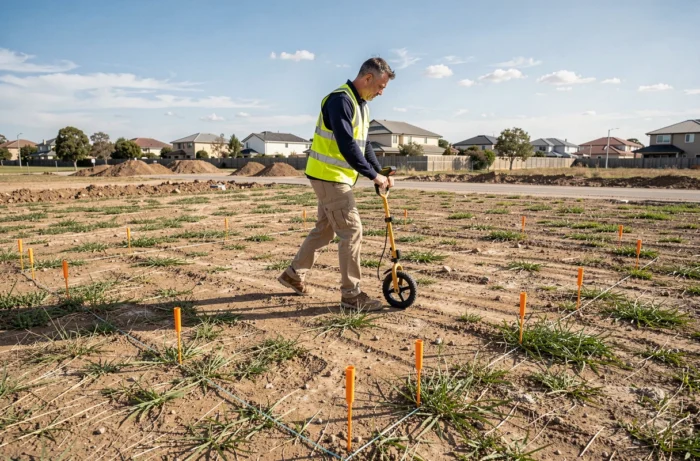
- For an outdoor plot, differential GPS surveying remains the reference method for expert surveyors, with centimeter-level precision
These tools do not exempt you from understanding the logic of calculation. A poorly framed LiDAR scan or a GPS survey conducted under dense vegetation can produce aberrant results. Verifying the result with a manual calculation remains good practice, especially when the measurement involves legal responsibility.
For a room or a plot with four unequal sides, the safest approach remains to measure a diagonal, break it down into triangles, and apply Heron. Digital tools speed up the process, but the rigor of the initial measurement conditions everything else.