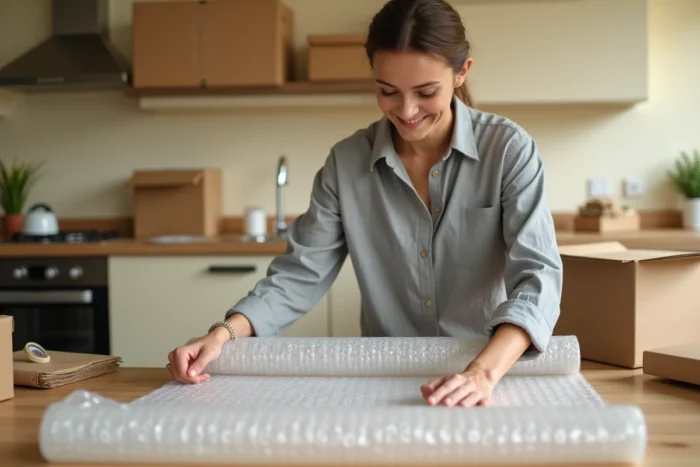
Bubble wrap remains the number one reflex for protecting fragile items during a move or when sending packages. Finding free bubble wrap requires a minimum of method, as sources vary in quantity, quality, and supply regularity. European regulations on plastic packaging are gradually changing what circulates in stores and warehouses, making some leads more reliable than others.
Plastic packaging regulations: what changes for free bubble wrap
Before listing recovery channels, a regulatory point is necessary. The AGEC law sets a 20% reduction in single-use plastic packaging by the end of 2025, with at least half through reuse. The European regulation PPWR (Regulation (EU) 2025/40) goes further: all packaging placed on the market must be recyclable by January 1, 2030, including protective plastic films.
The PPWR also imposes a 50% void limit in transport and e-commerce packaging. E-commerce retailers and logistics companies are therefore reducing their consumption of plastic stuffing in favor of kraft paper or reusable covers. The concrete result: stocks of recoverable bubble wrap in stores or warehouses decrease year after year.
This trend does not eliminate free bubble wrap, but it forces diversification of sources and quick action when an opportunity arises. Knowing where to find free bubble wrap becomes a trade-off between immediate availability and prospecting effort.
Free bubble wrap: comparison of sources by reliability and volume
Not all leads are equal. The table below ranks the main sources according to three practical criteria: average recoverable volume, supply regularity, and necessary effort.
| Source | Typical Volume | Regularity | Effort |
|---|---|---|---|
| Appliance or computer stores | High (large rolls, thick sheets) | Variable, depends on deliveries | Low (ask in reserve) |
| Decoration, dishware, lighting shops | Medium (pieces of various sizes) | Regular, frequent receptions | Low |
| Local online groups (Facebook, Leboncoin) | Variable (from a few meters to a whole roll) | Random, often after moves | Medium (monitoring + travel) |
| Warehouses and logistics areas | High | Regular | High (restricted access, direct contact) |
| Recycling centers and waste disposal sites | Low to medium | Random | Medium (sorting on-site, variable condition) |
| Pharmacies and laboratories (antistatic packaging) | Low (small quantities) | Regular | Low |
Specialized stores in fragile products (appliances, high-tech, decoration) generate the most exploitable volumes. Online groups provide useful support, but supply remains unpredictable.
Local stores and businesses: the most cost-effective method
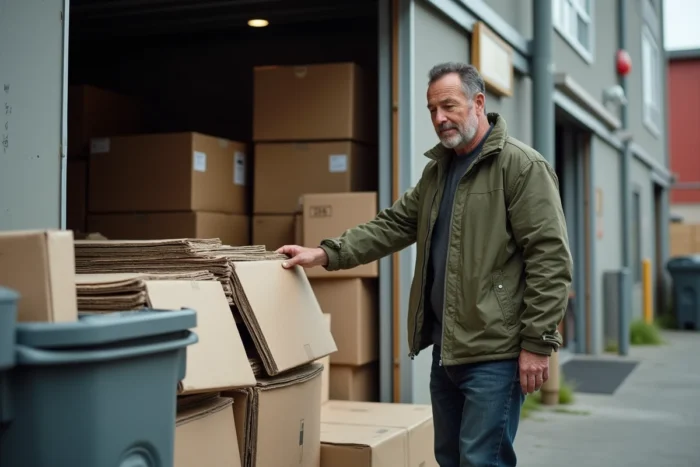
Stores that regularly receive fragile merchandise accumulate bubble wrap in reserve. Computer and appliance stores often throw away large, almost new sheets after unpacking products. Stopping by late in the morning, just after new deliveries are shelved, increases the chances of retrieving good-sized pieces.
Decoration shops, florists receiving vases, and opticians are less obvious but regular sources. The quantities are more modest, which is suitable for a one-time shipment or protecting a few fragile items.
Two points to check before retrieving
- The condition of the bubble wrap: the bubbles should be inflated. A film with crushed bubbles no longer protects anything and isn’t worth the trip.
- Cleanliness: bubble wrap retrieved from recycling centers or near bins may be dirty, damp, or punctured. A quick visual check prevents dirtying or damaging your items instead of protecting them.
- The size of the pieces: scraps smaller than 30 cm are difficult to use for wrapping a bulky item. Prioritize sources that generate sheets or whole rolls.

Online groups and associations: a useful but random supplement
Facebook groups like “donations” or “moving good deals” in your city allow you to retrieve bubble wrap after a recent move. Leboncoin, in the “free” category, also occasionally lists lots. Responsiveness makes the difference: free bubble wrap ads disappear within hours.
Some local associations (recycling centers, resource centers) collect packaging materials. They sometimes redistribute bubble wrap recovered from professionals. The advantage: sorting has already been done, and the materials offered are generally in good condition.
However, these channels do not guarantee quantity or frequency. For a complete move, rely on local businesses as the main source and use online groups to supplement.
Free alternatives to bubble wrap for packing fragile items
The gradual scarcity of bubble wrap in commercial circuits pushes consideration of substitutes available at no cost. Several options effectively protect fragile items.
- Crumpled newspaper: abundant and free, it cushions light shocks. Its limit: it does not protect against strong impacts and can stain certain surfaces.
- Textiles (towels, sheets, clothing): a thick fabric wrapped around an item absorbs shocks better than thin bubble wrap. Double function during a move, as the laundry must be transported anyway.
- Cut corrugated cardboard: recoverable from the same stores as bubble wrap, it offers a rigidity that plastic film lacks. Useful for stabilizing items in a box.
These alternatives do not replace bubble wrap for very fragile items (fine glassware, electronic components), but they cover the majority of domestic packing needs.
Free bubble wrap remains accessible as long as you target the right sources at the right time. Specialized stores in fragile products remain the most reliable channel, far ahead of online ads or recycling centers. Regulatory pressure on plastic packaging is gradually reducing available volumes: anticipating your needs a few days in advance, rather than searching the day before a move, makes all the difference.