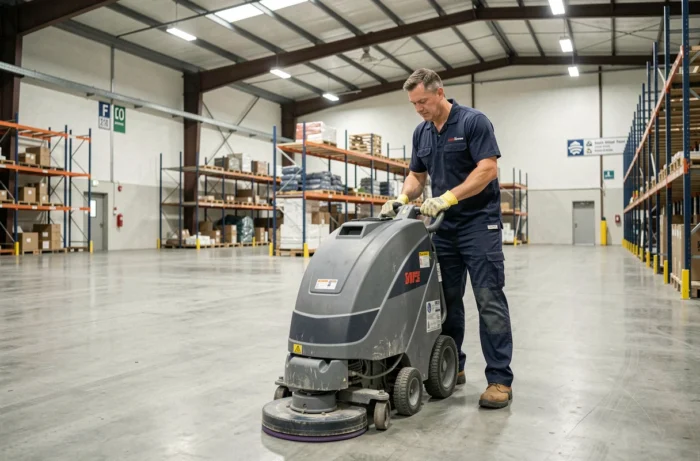
The cleaning of industrial and commercial premises is no longer just a matter of appearance. For several years now, the French regulatory framework has required operators to ensure documented, verifiable, and sometimes certified hygiene and safety conditions.
A lack of maintenance can lead to a breach of the Single Document for Professional Risk Assessment (DUERP), non-compliance during an audit, or liability in the event of a workplace accident. This context changes the very nature of the cleaning service: it becomes a link in operational compliance.
Certibiocide and industrial disinfection: an overlooked obligation for clients
Since 2026, the use of professional biocidal products (disinfectants, pest control) in a commercial or industrial setting requires the Certibiocide to be held by the service provider. This certification, issued after specific training, conditions the right to purchase and apply certain categories of regulated disinfectants.
For a client, entrusting the disinfection of their premises to a non-certified provider poses a direct legal risk. In the event of an inspection or health incident, the absence of Certibiocide from the service provider may be considered a failure of due diligence on the part of the client themselves.
Companies specializing in industrial cleaning now incorporate this certification into their offerings, which serves as a selection criterion during contract awarding. An organization like the one presented on https://www.apwn.fr/ offers services tailored to environments subject to these regulatory requirements.
Competing pages rarely address this aspect. Most focus on general benefits (time savings, brand image), while biocide compliance is an increasingly contractual and insurance-related issue for agri-food, pharmaceutical, or logistics sites.
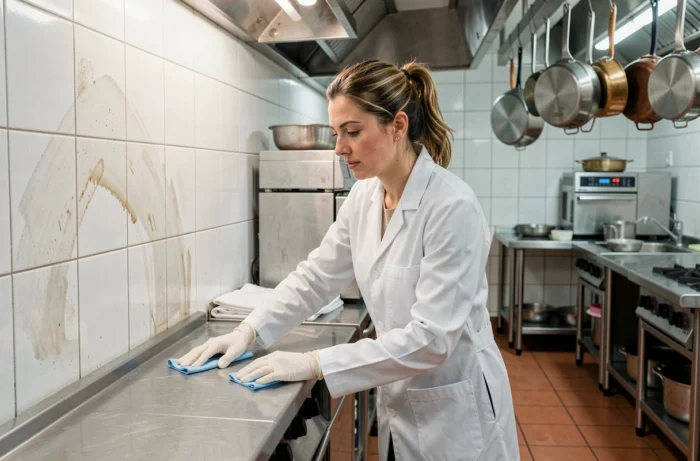
DUERP and cleaning: when the service provider engages the client’s responsibility
The DUERP requires each employer to identify and assess the professional risks to which their employees are exposed, including those related to the intervention of external companies. When a cleaning agent works in a warehouse or workshop, the client shares the responsibility for working conditions with the cleaning company.
A provider that does not have its own DUERP, or whose protocols are not up to date, weakens the legal position of the client. In the event of an accident involving a cleaning agent on site, the labor inspectorate examines the prevention plans co-signed by both parties.
Points of vigilance in the prevention plan
- The list of chemical products used by the provider and their safety data sheets, verified before the start of the service
- The adequacy of personal protective equipment (PPE) provided to agents in relation to the risks identified on site (slippery floors, dust, chemical vapors)
- The documented training of the agents on the specifics of the site, particularly the handling of hazardous substances present in the client’s premises
Field feedback published by DREETS Auvergne-Rhône-Alpes shows that situations of restoration after an incident are often poorly managed when entrusted to non-specialized providers. The absence of a clear protocol between the client and the cleaner is an identified risk factor.
PPE and training of cleaning agents: what the buyer must check
A professional cleaner is distinguished not only by their products or machines. The quality of an industrial service also relies on the training of its agents and the relevance of the PPE it provides.
The employer’s obligations regarding PPE are clear: provide protections suitable for the actual risk, maintain them, and train agents in their correct use. A provider that sends an agent to clean a floor contaminated by chemical residues with simple household gloves does not meet regulatory requirements.
A structured provider reduces the risk of inadequacy of protections because it has an internal reference framework by type of environment. Companies certified ISO 45001, for example, integrate PPE management into their occupational health and safety management system.
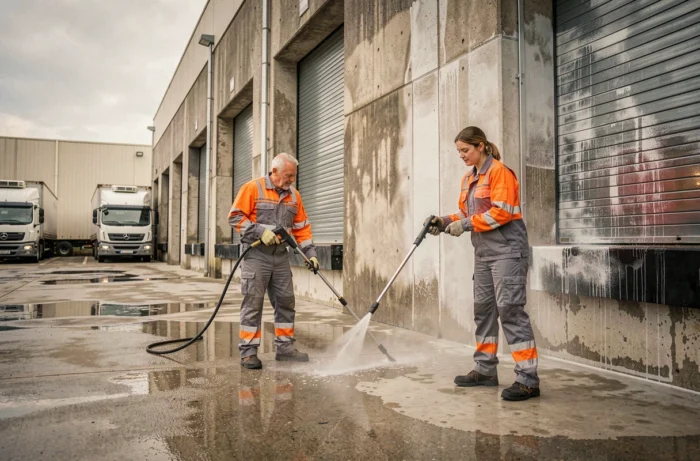
Required skills according to the type of premises
A logistics warehouse does not present the same risks as a commercial space open to the public. In the first case, agents must be trained in maneuvering equipment zones, marking, and handling concentrated cleaning products. In the second, the constraints are more about intervention times, discretion, and health standards related to public reception.
This distinction explains why specialized structures in industrial and commercial cleaning generally have differentiated protocols according to the classification of the site. Entrusting an industrial cleaning project to a provider accustomed only to tertiary offices ignores a significant part of the operational risk.
Outsourced industrial cleaning: the limits to know
Outsourcing cleaning does not eliminate all responsibility from the client. The client remains obliged to communicate all the risks present on their site, to update the joint prevention plan, and to verify that the provider meets its contractual commitments.
Field feedback varies on the ability of small providers to maintain a consistent level of compliance. A cleaning company with three employees may hold the Certibiocide and an up-to-date DUERP, but documentary traceability often remains fragile in small structures.
Moreover, the perceived quality of cleaning does not always reflect the actual quality. A visually clean floor may still be contaminated by biological or chemical residues if the disinfection protocols are not suited to the type of soiling. Surface sampling checks, common in the agri-food sector, regularly reveal discrepancies between appearance and microbiological reality.
Choosing a professional cleaner for industrial or commercial premises thus relies less on the promise of a visible result than on the provider’s ability to document their interventions, certify their agents, and share the burden of compliance with their client. It is this contractual and regulatory dimension that today separates a cleaning service from a true sanitary maintenance service.