
The women’s clothing market is undergoing a profound transformation. Customers no longer consume fashion as a seasonal flow of disposable pieces: they make choices between new, second-hand, and repair, often within the same point of sale. Understanding these dynamics allows for the construction of a daily style that is both current and sustainable over time.
Recommerce and circular fashion: the new style reflex
Second-hand is no longer a parallel circuit reserved for vintage. Mass market brands like Kiabi have deployed integrated eco-responsible pathways in-store: second-hand corners, clothing collection, spaces dedicated to more sustainable fashion. Customers now navigate between classic aisles and circular offerings within the same location.
This context changes the way a wardrobe is composed. Each piece purchased must justify its place across several seasons, which naturally leads to timeless cuts, materials resistant to repeated washing, and colors that are easy to restock. Recommerce also encourages a reconsideration of the perceived value of a garment: a well-cut jacket found second-hand retains more stylistic potential than a low-quality new piece worn three times.
We observe that consumers today expect brands to provide concrete solutions for take-back, alteration, and textile recycling. This is no longer a peripheral marketing argument; it is a structural expectation that directly influences wardrobe choices. Exploring fashion according to Belle et Épanouie allows us to see how this demand translates into concrete style proposals.
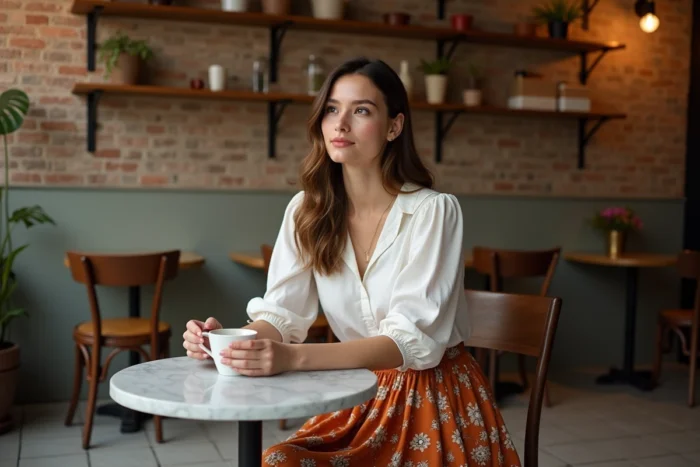
Versatile women’s pieces: building a functional wardrobe
The pressure on the clothing market pushes towards more versatile styles. Rather than multiplying seasonal purchases, we recommend concentrating the budget on pieces with high rotation potential.
Selection criteria that change everything
- The density of the fabric: a sufficiently dense weight ensures durability and a more flattering drape, whereas a fabric that is too thin deforms after a few washes
- Adjustable chromatic neutrality: favor a base of muted colors (ecru, heather gray, navy blue, khaki) that can accommodate bright-colored accessories without creating dissonance
- Mid-structured cut: neither too fitted (which quickly becomes obsolete if trends shift), nor too oversized (risk of a neglected look in daily wear). The semi-fitted style remains the best compromise for office-weekend
A rotating wardrobe relies on about ten key pieces, not on an accumulation of complete looks. The tailored trousers, the straight dress in thick knit, the straight or slightly flared jeans, and the structured short jacket form a core that accessories can modulate.
The common mistake: buying by isolated trend
Following a micro-trend without checking its compatibility with the rest of the wardrobe generates orphan pieces. Balloon jeans or butter yellow, for example, only work if the rest of the wardrobe can accommodate them. We recommend mentally testing three complete outfits with a piece before purchasing it. If three convincing combinations do not come quickly, the piece will end up at the back of the closet.
Trendy colors and materials for women: reading signals beyond the runway
The seasonal palettes communicated by brands no longer dictate daily style as they once did. Consumers use them more as a selection filter than as a standard. What matters is the coherence between the personal palette and the current proposals.
Earthy tones and desaturated pastels dominate spring-summer proposals because they respond to a demand for versatility. A rosy beige or sage green can be worn both on top and bottom, in the office or outdoors. Saturated colors (bright red, electric orange) remain confined to accessories or accent pieces, rarely to basics.
In terms of materials, structured knit and blended linen are gaining ground over standard polyester. The choice of material conditions the final result more than the cut itself. A straight dress in thick linen does not produce the same effect as an identical cut in fine viscose. Touching the fabric, checking the composition, and anticipating its behavior when ironing are part of the selection process, not just accessory details.
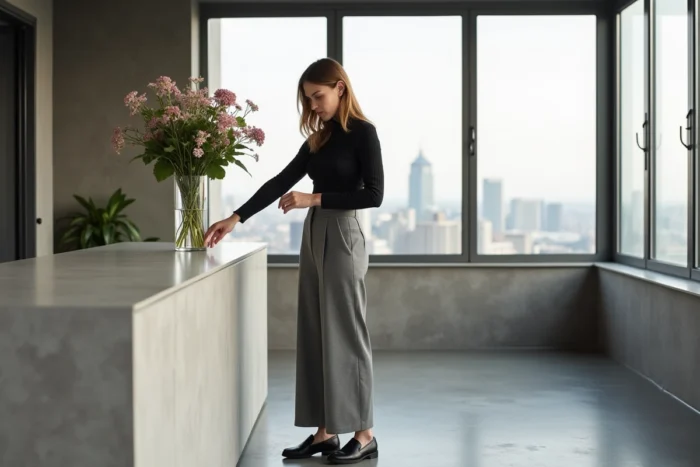
Women’s fashion accessories: the most underestimated differentiation lever
Accessories represent the tipping point between a functional wardrobe and an identifiable style. On social media, the return of high heels on recent runways confirms that shoes structure a look just as much as the main piece.
- The visible buckle belt redefines the silhouette on a flowing dress or high-waisted pants without adding volume
- The medium-sized bag (neither micro nor tote) remains the most versatile for daily use, suitable for both office and outings
- Jewelry in brushed metal or ceramic is gradually replacing shiny jewelry, in line with the matte and textured aesthetic that dominates current trends
A well-chosen accessory makes a basic outfit immediately recognizable. This is where unit investment is most justified, because a quality accessory transcends seasons without undergoing the mechanical wear of a garment worn against the skin.
TikTok micro-trends and sustainable style: the right balance
Viral micro-trends (quiet luxury, coquette, mob wife) succeed one another at a pace that makes any systematic adoption counterproductive. Their lifespan ranges from a few weeks to a quarter. Integrating them should be done in touches, never through complete overhauls.
Generation Z, the driver of these rapid cycles, simultaneously shows a growing interest in circularity and sustainability. Adopting a micro-trend through an accessory or a second-hand piece allows for testing an aesthetic code without heavy financial or ecological commitment.
The most solid daily style rests on a stable foundation enriched with controlled variations. Women’s fashion trends are not a catalog to follow line by line, but a vocabulary from which one picks the words that correspond to their own wardrobe syntax. The best piece of the season is the one you will still wear in two years.